
Your training programs are forgetting faster than learners can close their laptops. Despite investing in sophisticated platforms and content libraries, retention rates hover disappointingly low, and behavioral change remains elusive. The problem isn’t the information you’re delivering—it’s how you’re delivering it.
Compelling storytelling transforms forgettable training into memorable experiences that drive measurable performance improvements. When you structure learning content as narrative rather than bullet points, you activate multiple brain regions simultaneously, creating stronger neural pathways and increasing retention by up to 65%. This isn’t creative embellishment—it’s applied neuroscience that directly impacts your business outcomes.
Learning and development professionals who master storytelling techniques gain a competitive advantage in an environment where engagement metrics increasingly determine program success. The framework isn’t complex: identify the learner’s challenge, create tension through realistic scenarios, introduce knowledge as the solution, and demonstrate transformation through relatable characters. Yet most corporate training still relies on information dumps that our Neurolearning™ research shows are processed and promptly forgotten.
This shift requires more than adding anecdotes to PowerPoint slides. It demands understanding how narrative structure aligns with cognitive processing, how emotional resonance creates memory anchors, and how story arcs can mirror the learner’s own development journey. The L&D professionals who implement these principles don’t just improve completion rates—they create learning experiences that participants actively seek out and voluntarily share, fundamentally changing how organizations build capability and drive performance.
The Forgetting Curve Problem: Why Traditional Training Doesn’t Stick
Picture this: Your organization just invested $50,000 in a comprehensive training program. Employees dutifully attend sessions, take notes, and score well on post-training assessments. Six weeks later, they’ve forgotten nearly 70% of what they learned. Sound familiar?
This isn’t a failure of willpower or attention. It’s neuroscience.
In 1885, psychologist Hermann Ebbinghaus discovered what we now call the “forgetting curve,” a mathematical representation of how rapidly we lose information over time. His research revealed that without reinforcement, people forget approximately 50% of new information within hours, and up to 90% within a month. Despite being over a century old, this finding remains painfully relevant in today’s corporate training landscape.
The fundamental problem lies in how traditional training delivers information. Most programs operate on a “fire hose” model, flooding learners with facts, procedures, and data in compressed timeframes. The brain, however, doesn’t work like a hard drive where you can simply upload and store information. It prioritizes retention based on emotional significance, contextual relevance, and meaningful connections.
This is where Neurolearning™ principles become essential. Modern neuroscience shows that our brains are wired for narrative processing. Information embedded in stories activates multiple brain regions simultaneously, including those responsible for sensory experience, emotion, and motor activity. When learners encounter dry facts in isolation, only language processing centers engage. The result? Minimal retention and near-zero behavioral change.
For L&D professionals, this represents more than a pedagogical challenge. It’s a business crisis. Organizations pour millions into training initiatives that produce negligible ROI because the content design fundamentally misaligns with how human memory actually functions. The solution isn’t more training or longer sessions. It’s reimagining how we structure learning experiences to work with, rather than against, the brain’s natural learning architecture.
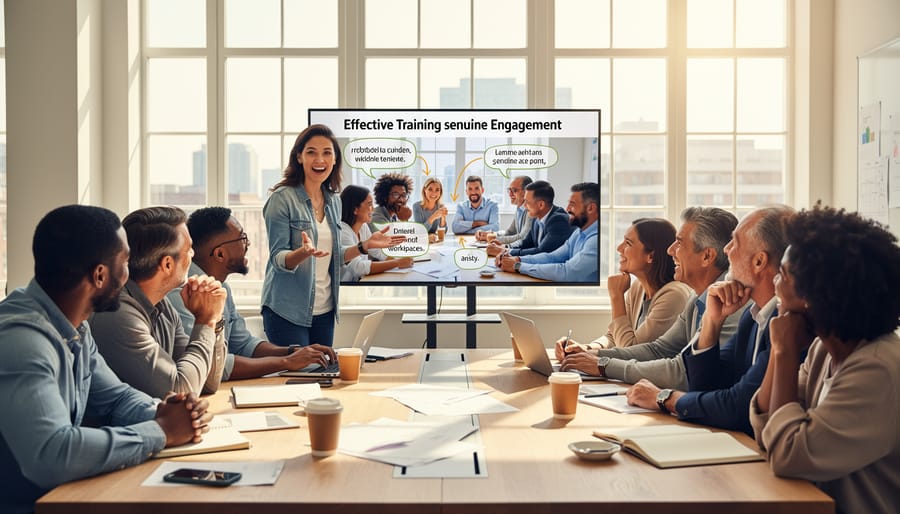
What Makes a Story ‘Compelling’ in Learning Contexts
The Three Pillars of Learning Stories
Effective learning stories rest on three fundamental pillars that align with how our brains process and retain information. Understanding these components transforms storytelling from an art into a strategic learning tool grounded in Neurolearning™ principles.
The first pillar, relatability, establishes immediate cognitive connection. When learners recognize themselves in a story’s protagonist—whether it’s a customer service representative handling a difficult call or a manager navigating team conflict—their mirror neurons activate, creating neural patterns similar to actual experience. This neurological engagement moves content from abstract concepts to lived scenarios. For corporate training, relatability means crafting characters and situations that reflect your learners’ daily realities, complete with authentic details like industry-specific challenges, familiar workplace dynamics, and recognizable decision points.
The second pillar, conflict or challenge, maintains attention and emotional investment. Our brains are wired to seek resolution; unresolved tension creates cognitive gaps that demand closure. In learning contexts, this tension mirrors the real-world problems your audience faces. When a story presents a compliance dilemma, a leadership crisis, or a customer complaint scenario, learners instinctively engage problem-solving mechanisms, priming them for the learning that follows. This active mental participation significantly enhances retention compared to passive information consumption.
The third pillar, resolution, delivers both emotional satisfaction and practical application. The resolution phase demonstrates not just what happened, but why specific actions led to success. This is where learning crystallizes into actionable insight. By showing consequences and outcomes, you help learners build mental models they can reference when facing similar situations in their own work environments. The resolution transforms the story from entertainment into a strategic learning asset with measurable impact.
Emotional Resonance Meets Practical Application
The most powerful learning stories function as bridges between emotion and action. While a compelling narrative captures attention and creates memorable moments, its true value emerges when learners can immediately translate those insights into workplace behaviors. This balance requires intentional design that respects both the heart and the mind.
Consider how Neurolearning™ principles inform this approach: emotional engagement activates the limbic system, enhancing memory consolidation, while structured takeaways provide the prefrontal cortex with clear implementation pathways. When stories conclude with specific action steps or decision-making frameworks, learners experience both the inspiration to change and the roadmap for doing so.
Effective implementation involves embedding practical checkpoints throughout your narrative. After presenting a challenge scenario, prompt learners to identify parallel situations in their roles. Following character resolutions, offer templated tools or conversation guides they can adapt immediately. This design thinking approach ensures stories don’t simply entertain but transform into performance assets.
Measurable outcomes validate this dual focus. Track not just completion rates or satisfaction scores, but behavior change indicators: application of learned techniques, improved decision-making speed, or enhanced customer interactions. When emotional resonance drives genuine skill development, your storytelling investment delivers quantifiable business impact.
How Storytelling Activates Multiple Brain Regions
When learners encounter a well-crafted story, something remarkable happens in their brains. Unlike simple fact recitation, which primarily activates language processing centers, storytelling simultaneously engages multiple neural regions, creating a richer, more memorable learning experience. This multisensory activation forms the foundation of effective Neurolearning™ approaches.
Research using functional MRI technology reveals that stories activate the sensory cortex, motor cortex, and emotional processing centers alongside traditional language areas. When a learner hears about a manager navigating a difficult conversation, their brain doesn’t just process words. It simulates the emotional tension, imagines the physical setting, and rehearses potential responses. This neural mirroring creates what neuroscientists call “embodied cognition,” where the brain processes information as if the learner were experiencing the situation firsthand.
The implications for learning retention are substantial. Studies show that information delivered through narrative can be up to 22 times more memorable than facts alone. This happens because stories create what cognitive scientists call “episodic memory,” the same type of memory we use to recall personal experiences. When multiple brain regions fire together during story processing, they create stronger neural pathways and more retrieval cues for later recall.
The emotional component proves particularly powerful. The amygdala, our brain’s emotional processor, acts as a memory enhancer. When stories trigger emotional responses, they signal the brain that this information matters, strengthening encoding and consolidation. This explains why learners readily remember case studies with compelling characters but struggle to recall isolated statistics from the same training session.
For learning professionals, understanding this neurological foundation transforms how we approach content design. By intentionally crafting narratives that engage visual, emotional, and motor regions, we’re not simply making learning more enjoyable. We’re leveraging fundamental brain architecture to create deeper, more durable learning outcomes that translate directly into workplace performance.

Four Storytelling Frameworks That Transform Learning Content
The Challenge-Solution-Impact Framework
This framework transforms dry compliance content into memorable learning experiences by structuring narratives around real workplace obstacles. Rather than presenting abstract rules, learners encounter authentic scenarios where employees face specific challenges that regulations or procedures solve.
Consider cybersecurity training. Instead of listing password requirements, present Maria, a sales manager who lost a major client pitch when competitors accessed her unsecured account. The challenge becomes tangible. The solution—implementing multi-factor authentication and strong password protocols—directly addresses her problem. The impact shows Maria confidently presenting again, with client data secured and her reputation restored.
This approach aligns with Neurolearning principles by activating the brain’s problem-solving mechanisms. When learners see consequences and resolutions, they create stronger memory pathways than passive information absorption provides. The emotional connection to Maria’s predicament makes the procedural content stick.
For procedural training, map each step to solving a specific problem. Financial reporting procedures become more compelling when framed as preventing audit failures that cost companies reputation and resources. The challenge-solution-impact structure converts compliance requirements from checkbox activities into meaningful business tools that protect both individuals and organizations.
This framework consistently delivers higher knowledge retention and practical application rates in workplace settings.
The Journey Framework
The Journey Framework maps learning experiences as transformational narratives, making it particularly powerful for onboarding sequences and leadership development programs. This approach mirrors the classic hero’s journey structure, positioning learners as protagonists navigating challenges, acquiring new capabilities, and emerging transformed.
When designing career development pathways, structure content around distinct phases: the current state (establishing context), the call to growth (identifying skill gaps), trials and mentorship (skill acquisition through realistic scenarios), and transformation (demonstrating mastery). This framework taps into Neurolearning™ principles by creating emotional investment in the outcome while providing clear progression markers that satisfy our brain’s need for pattern completion.
For implementation, consider a sales leadership program where participants progress from individual contributor challenges through team management scenarios to strategic decision-making. Each phase builds on previous learning while introducing increasingly complex situations. The journey structure naturally incorporates spaced repetition and progressive complexity, two evidence-based learning principles that enhance retention.
This framework also facilitates meaningful assessment by tracking competency development across the journey stages, providing both learners and stakeholders with tangible evidence of growth aligned to business objectives.
The Case Study Framework
The case study framework transforms learners into decision-makers by placing them inside authentic business scenarios. Rather than passively absorbing information, participants analyze real situations, evaluate options, and experience the consequences of their choices—mirroring the complexity they’ll encounter in their actual roles.
This approach leverages Neurolearning™ principles by activating the brain’s pattern-recognition systems. When learners work through realistic challenges—whether it’s navigating a customer conflict, managing a budget shortfall, or implementing organizational change—they create mental models that transfer directly to workplace performance.
Design thinking enhances this framework by structuring case studies around problem-solving journeys. Begin with context and stakeholder perspectives, introduce complications that require critical analysis, then guide learners through decision points where multiple valid solutions exist. This mirrors real business complexity where perfect answers rarely exist.
The measurable advantage? Case studies create retrieval practice, strengthening memory consolidation while building confidence. Track learner decision patterns, reasoning quality, and application of key concepts. For maximum engagement, use multimedia elements like stakeholder interviews, data visualizations, and branching scenarios that reveal different outcome paths based on choices made.
The ‘Day in the Life’ Framework
This powerful framework transforms abstract concepts into tangible experiences by placing learners directly into realistic workplace scenarios. Rather than explaining a process or policy from a distance, you invite learners to step into someone else’s role for a day, building deep empathy and understanding that transcends traditional training boundaries.
The approach works because it activates the brain’s mirror neuron system, which responds to observed experiences nearly as strongly as lived ones. When a finance professional follows a sales representative through challenging customer interactions, or when executives experience the frontline employee perspective, Neurolearning™ principles show increased retention and behavioral change.
Implementation begins by mapping a typical day for the role you want to illuminate. Include authentic challenges, decision points, and emotional moments. Structure the narrative around three to five key scenarios that highlight critical learning objectives while revealing the pressures, constraints, and motivations that drive behavior in that position.
Design thinking enhances this framework by ensuring scenarios reflect genuine workplace realities rather than idealized versions. Interview actual role holders, capture their language and concerns, then craft interactive decision points where learners experience consequences of choices. This creates memorable learning moments that bridge departmental divides and foster genuine collaboration across organizational boundaries.
Design Thinking: Building Stories Around Learner Needs
Design thinking and storytelling share a fundamental principle: they both begin with deep empathy for the user. When you build learning narratives around genuine learner needs, you create experiences that resonate at a neurological level, triggering the engagement mechanisms that Neurolearning™ principles reveal as critical for retention and behavior change.
The design thinking approach to story development starts with rigorous learner research. Before crafting a single narrative element, ask: What challenges keep your learners awake at night? What goals drive their daily decisions? What contextual pressures shape their workplace reality? A compliance training story that acknowledges the tension between speed and safety will land differently than one that simply lists regulations. This empathy-driven foundation transforms generic content into personally relevant experiences.
Consider how traditional training often presents scenarios from an organizational perspective: “Here’s what the company needs you to know.” Design thinking flips this narrative. A customer service training story might follow a representative navigating a difficult call, capturing the emotional weight of managing angry customers while meeting response time metrics. The learner sees themselves in the protagonist because the story mirrors their actual pain points.
The prototyping mindset of design thinking applies directly to story development. Create multiple narrative approaches for the same learning objective, then test them with representative learners. Which opening hook captures attention? Which character struggles feel authentic? Which resolutions feel achievable? This iterative process prevents the common trap of stories that exist solely to deliver content rather than to illuminate genuine challenges.
Context mapping becomes your story blueprint. Document the physical, emotional, and social environment where learners apply new skills. A leadership development narrative set in a busy manufacturing floor creates different cognitive connections than one set in a quiet office. These contextual details aren’t decorative; they’re neurological anchors that help learners mentally rehearse applying skills in their actual work environment.
The measure of user-centered storytelling isn’t whether learners enjoyed the narrative. It’s whether they recognize themselves in the challenges presented and can envision themselves implementing the solutions. When stories authentically reflect learner realities, they don’t just convey information; they validate experiences, build confidence, and create mental models for future action. This is where design thinking principles transform storytelling from entertainment into a precise learning tool with measurable business impact.

Measuring the Impact: How to Prove Storytelling Works
The most common objection to storytelling in learning programs is simple: “Show me the numbers.” And rightfully so. Investment in learning initiatives demands demonstrable returns, which means moving beyond anecdotal success stories to concrete data.
Start with engagement metrics that reveal how learners interact with your content. Track completion rates, time-on-task, and voluntary replay instances. Story-based modules consistently outperform traditional formats, often showing 20-40% higher completion rates. Monitor click-through rates on interactive story elements and participation in scenario-based activities. These metrics indicate whether your narrative is capturing and sustaining attention, fundamental to the Neurolearning™ principle that emotional engagement enhances memory formation.
Knowledge retention provides your next proof point. Compare pre-assessment and post-assessment scores between story-based and traditional modules. More telling, conduct 30-day and 90-day retention tests. Research consistently demonstrates that information embedded in narrative contexts shows significantly higher recall rates. When learners remember the story, they remember the lesson.
Performance indicators connect learning to business outcomes. Identify specific behaviors or competencies your storytelling addresses, then track relevant KPIs. If your compliance training uses scenario-based storytelling, measure incident reduction rates. For sales enablement stories, track conversion improvements or deal closure times. Customer service narratives should correlate with satisfaction scores or resolution efficiency.
Design thinking approaches help you establish baseline measurements before implementing storytelling interventions, making impact comparison straightforward. Create control groups using traditional content formats alongside story-enhanced versions to generate comparative data.
Qualitative feedback matters too. Post-training surveys asking learners to rate relevance, emotional connection, and applicability provide insights that pure numbers miss. Comments like “I finally understand why this matters” or “I’ll actually use this” signal that your story created meaning, not just information transfer.
The combination of quantitative metrics and qualitative feedback builds an evidence-based case for storytelling’s ROI, transforming skeptics into advocates through data they cannot ignore.
From Bullet Points to Narratives: A Practical Conversion Process
Transforming traditional training content into engaging narratives doesn’t require starting from scratch. The conversion process follows a systematic approach that leverages your existing materials while applying Neurolearning™ principles to enhance retention and application.
Begin by identifying your core learning objective within the bullet-pointed content. Extract the essential knowledge or skill you need learners to acquire. For instance, in chemistry safety training, your bullet point might read: “Always wear protective equipment in the laboratory.” This factual statement contains vital information but lacks emotional resonance.
Next, construct a relatable character facing a realistic challenge. This character should mirror your learner’s role and experience level. Consider Maria, a new laboratory technician excited about her first independent project. She’s competent but hasn’t yet internalized why certain protocols exist beyond mere compliance.
Now, introduce a complication that creates tension without being catastrophic. Maria notices her safety goggles are slightly scratched and considers whether they’re adequate for her current task. This moment of decision-making becomes your teaching opportunity.
Transform your bullet point into narrative dialogue or internal reflection: “Maria held up her goggles to the light, noticing the fine scratches across the lens. Her supervisor’s words echoed: ‘Compromised equipment compromises safety.’ The replacement goggles were just across the lab, but her experiment timeline was tight. She paused, remembering the incident report from last month—a colleague’s minor eye injury from a ‘quick task’ that seemed low-risk.”
This before-and-after demonstrates the shift from directive to decision-making scenario. The narrative embeds the same safety protocol but activates different neural pathways through emotional engagement and contextual reasoning.
For business training, apply the same framework. Convert “Effective leaders provide regular feedback” into a scenario where James, a new manager, struggles with addressing a team member’s declining performance. Show his internal debate, the conversation that follows, and the outcome—both immediate and downstream effects on team dynamics.
The conversion process works because it transforms passive information reception into active cognitive processing. Learners don’t just memorize the rule; they experience the reasoning behind it. This approach aligns with design thinking methodology by placing the learner’s experience at the center of content development.
When converting your content, maintain the factual accuracy while building the emotional scaffolding that makes information memorable and actionable in real-world contexts.
The evidence is clear: compelling storytelling isn’t just a creative flourish in learning design—it’s a fundamental mechanism for creating sustainable learning outcomes. When we apply Neurolearning™ principles to storytelling frameworks, we activate the precise neural pathways that facilitate retention, transfer, and behavioral change. The learners who connect emotionally with narrative-driven content don’t just remember information longer; they apply it more effectively in their day-to-day work.
For L&D professionals, this represents both a challenge and an extraordinary opportunity. The challenge lies in moving beyond traditional content dumps and bullet-pointed slides. The opportunity? To fundamentally transform how your organization learns, grows, and adapts. By integrating design thinking into your content strategy, you can systematically identify where storytelling will deliver the greatest impact and build measurable frameworks that demonstrate ROI to stakeholders.
Imagine learning experiences where employees genuinely look forward to training. Where completion rates soar not because of compliance requirements, but because the content resonates. Where knowledge retention extends beyond the quarterly assessment into lasting performance improvement. This isn’t aspirational thinking—it’s the documented result of applying storytelling principles grounded in neuroscience and measured through rigorous analytics.
The question isn’t whether storytelling works in learning. The question is: when will you begin harnessing its power to create the transformative learning experiences your organization deserves?