
TSSA compliance eLearning delivers measurable reductions in training time and cost while meeting Ontario’s technical standards for boiler, pressure vessel, and fuel-handling operations. Organizations adopting structured digital pathways report 40-60% faster certification preparation, improved knowledge retention, and the ability to scale training across multiple sites without sacrificing regulatory rigor or operational safety.
Traditional TSSA compliance training faces persistent challenges: scheduling conflicts that delay certification, inconsistent instruction quality across providers, and limited opportunities for learners to practice complex procedures before facing high-stakes assessments. For L&D teams managing technical workforces, these friction points translate directly to extended downtime, increased operational risk, and training budgets that spiral beyond initial projections.
The solution lies in purpose-built eLearning pathways that integrate Neurolearning principles with Ontario’s specific regulatory requirements. This approach doesn’t simply digitize existing materials. Instead, it reconstructs the learning experience around how technical professionals actually acquire and retain procedural knowledge under workplace conditions.
Design thinking drives this reconstruction. By mapping the cognitive load of TSSA regulations against real-world application scenarios, effective eLearning creates spaced repetition cycles, adaptive assessments, and simulation-based practice that mirror the conditions learners will face during certification and on the job. The result is training that aligns business continuity goals with individual learning needs.
For organizations preparing teams for TSSA power engineering exams and related certifications, the strategic advantage becomes clear: faster time-to-competency, documented compliance trails for audits, and training infrastructure that scales with workforce growth.
Understanding TSSA Certification Requirements in Ontario
The Technical Standards and Safety Authority governs the equipment and systems that power Ontario workplaces: boilers, pressure vessels, elevating devices, fuels, and upholstered and stuffed articles. If your organization operates industrial heating systems, commercial elevators, natural gas installations, or pressure-driven machinery, chances are you’re operating under TSSA jurisdiction. TSSA regulates elevators and fuels alongside other critical infrastructure, meaning non-compliance can ground operations overnight.
Who needs certification depends on the equipment and the role. Certification for boilers and pressure vessels applies to chief engineers, operating engineers, and power engineers across various classes, each tied to plant size and complexity. Elevator mechanics, fuel technicians, and gas fitters require their own credentials. If your team touches regulated equipment, they likely need to prove competency through TSSA-recognized training and examination.
The traditional pathway looks straightforward on paper: enroll in an approved course, attend in-person sessions, pass the exam, maintain records. In practice, it’s a logistical maze. Classroom schedules rarely align with shift work. Sending a technician across the province for a three-day course means pulling them offline, booking travel, and hoping the instructor covers the specific equipment your site uses. Content delivery varies wildly between providers, so two engineers from the same facility can walk away with different understandings of the same regulation.
Tracking becomes a paperwork nightmare. Certificates expire, renewals get missed, and during an audit, you’re scrambling through filing cabinets to prove compliance. Meanwhile, the training itself often feels disconnected from the job: generic slides about code sections rather than how to apply those rules when a boiler alarm goes off at 2 a.m. You’re left with checked boxes but uncertain whether your team truly understands the standards that keep people safe.
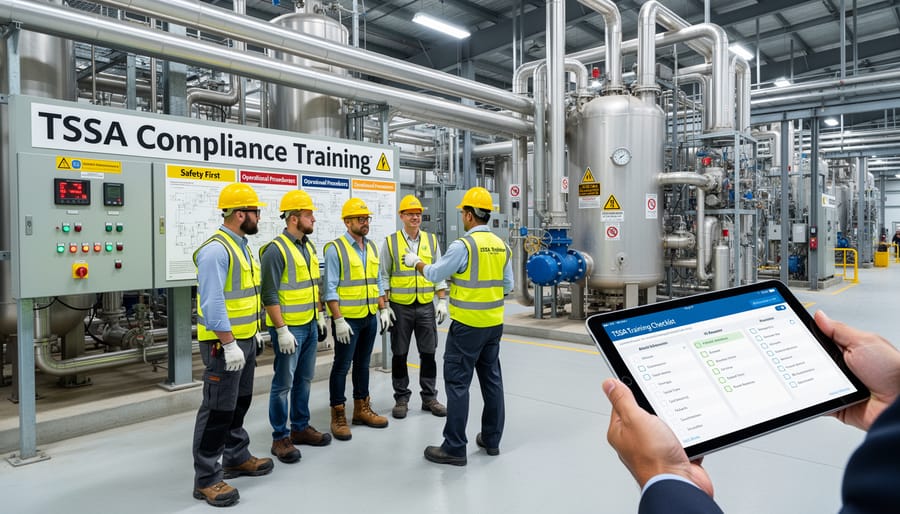
Why Traditional TSSA Training Falls Short
Walk into a TSSA training session scheduled for 9 a.m. on a Tuesday in downtown Toronto, and you’ll likely find a room half-empty. The foreman from Sudbury couldn’t make the drive. Two technicians called in sick, or said they did, because they couldn’t afford another day off the tools. The instructor is excellent, but she’s delivering the same PowerPoint deck she used three years ago, before the 2024 regulatory updates. Everyone takes notes, signs the attendance sheet, and returns to work. Three months later, when an inspector asks about proper documentation procedures for pressure vessel inspections, those notes are buried in a truck cab or a locker, and the knowledge has faded.
This is the reality of traditional TSSA compliance training across Ontario. The classroom model creates scheduling nightmares that force businesses to choose between operational continuity and regulatory compliance. When your certified staff are scattered across multiple sites, a reality for most organizations operating beyond the GTA, gathering everyone in one location means lost billable hours, travel costs, and the logistical puzzle of coordinating shifts. The result? Training gets postponed until it becomes urgent, then rushed through without adequate absorption.
Even when you overcome the scheduling barrier, consistency remains elusive. Different instructors emphasize different aspects. The quality of delivery varies by session and location. Assessment rigor fluctuates. Some trainers excel at translating regulations into workplace application; others default to reading standards documents aloud. For organizations managing remote employee training across Ontario’s vast geography, this inconsistency creates compliance gaps that audits expose, usually at the worst possible moment.
The tracking problem compounds everything else. Paper certificates get lost. Spreadsheets fall out of date. When renewal deadlines approach, scrambling begins. There’s no systematic way to verify who knows what, who needs refresher training, or whether the training delivered actually changed behavior on the job site. You’re managing compliance through hope and administrative patchwork rather than confidence and data.

How eLearning Pathways Transform TSSA Compliance
Personalized Learning Paths That Stick
Traditional TSSA training treats learners like identical containers to fill with information. A boiler technician with fifteen years of field experience sits through the same material as a newly hired facility manager, both expected to absorb identical content at the same pace. The result? Frustration, disengagement, and forgotten procedures the moment the course ends.
Neurolearning compliance approaches start differently. They assess what each learner already knows, then build pathways that connect new TSSA requirements to existing mental frameworks. A technician who regularly works with pressure vessels gets training scenarios rooted in troubleshooting familiar equipment. An administrative supervisor receives the same regulatory content through workflow and documentation contexts they encounter daily.
This isn’t just about convenience. Neurolearning principles recognize that the brain consolidates information through pattern recognition and emotional resonance, not repetition. When a learner encounters a TSSA safety protocol embedded in a realistic incident scenario, complete with consequences, decision points, and corrective actions, the regulation becomes memorable because it matters in a recognizable context.
Adaptive pathways also adjust difficulty based on performance. Struggle with pressure vessel classifications? The system provides additional examples and low-stakes practice before advancing. Demonstrate mastery quickly? Skip ahead to application exercises rather than sitting through redundant explanations. The training respects the learner’s time while ensuring genuine understanding, not just completion.
Real-World Scenarios Through Storytelling
Stories stick where bullet points bounce off. When a TSSA compliance module opens with a maintenance technician discovering a boiler pressure gauge reading in the red zone, learners lean in. The narrative unfolds: What should they check first? Who needs to be notified? What documentation is required? This scenario-driven approach transforms abstract regulations into lived experience.
Design thinking places learners inside decision points they will actually face. A fuel handling course might follow a delivery driver through a typical workday, embedding TSSA storage and transfer protocols within routine tasks rather than presenting them as disconnected rules. Learners navigate the same judgment calls they encounter on-site: verifying tank capacity before unloading, recognizing when atmospheric conditions require modified procedures, documenting variances.
The emotional weight of consequences makes training memorable without resorting to scare tactics. When a story shows how overlooking a single step in elevator maintenance inspection cascades into equipment failure and worker risk, the regulation becomes personal. Learners internalize the why behind each requirement because they have witnessed the outcome, even in a simulated environment. Context creates commitment that checklists cannot.

Building an Effective TSSA eLearning Pathway
Building a TSSA compliance eLearning pathway begins with understanding what your organization actually needs. Don’t start with content, start with context. Map which roles require which certifications, identify the specific equipment or systems your teams work with, and pinpoint where compliance gaps exist. A facility managing both boilers and elevating devices needs different pathway branches than one focused solely on fuel handling. This needs assessment prevents the common mistake of building one-size-fits-all training that leaves learners wading through irrelevant material.
Structure your content around job tasks, not abstract regulation numbers. When you teach pressure vessel inspection requirements, frame them within the actual inspection workflow your technicians follow. Use the Neurolearning™ principle of contextual embedding: learners retain information when they encounter it within the situations where they’ll apply it. Break modules into focused units that respect working memory limits, 20 minutes maximum per segment. Each unit should address one competency, provide immediate practice, and connect to the next logical skill.
Assessment design matters more than most organizations realize. Multiple-choice questions that ask learners to recall TSSA section numbers prove nothing about competency. Instead, create scenario-based assessments where learners diagnose a situation, choose appropriate actions, and justify their decisions against regulatory requirements. Include branching scenarios that reveal consequences of incorrect choices without real-world risk. These assessments become learning experiences themselves, not just checkpoints.
Documentation needs dual tracks. Build automated reporting that captures completion, scores, and time-to-competency for compliance audits. Simultaneously, design portfolio elements where learners document how they’ve applied training in their actual work. This creates evidence of competency that goes beyond attendance records. Integrate this pathway with your broader learning ecosystem, whether that’s your LMS, new employee onboarding sequences, or performance management systems. Compliance training shouldn’t live in isolation, it’s part of how your organization builds capability.
Keep pathways modular so you can update individual segments as TSSA requirements evolve without rebuilding everything. Regulations change; your training architecture should anticipate that. Design once, iterate continuously. This approach transforms compliance training from a grudging obligation into a systematic capability builder that actually reduces operational risk while respecting your learners’ time.
Measuring Outcomes Beyond the Checkmark
Completion rates tell you who finished the course. They don’t tell you who can actually perform the work safely. Effective TSSA compliance measurement requires tracking three layers: knowledge acquisition, behavioral application, and operational impact. Each layer builds on the previous one, creating a full picture of training effectiveness rather than just a roster of checkmarks.
Start by assessing competency through varied evaluation methods. Multiple-choice quizzes have their place for testing recall of procedures and regulations, but pair them with scenario-based assessments that require learners to apply TSSA requirements to realistic situations. Interactive review games can reveal whether someone truly understands when and why specific protocols matter, not just that they exist. Track performance patterns across attempts to identify knowledge gaps that need reinforcement before certification.
The real test happens on the floor. Behavioral metrics measure whether training translates into changed practice. Observe work procedures post-training, conduct spot audits of documentation practices, and track near-miss reports as a leading indicator. When technicians consistently apply lock-out procedures or properly document pressure vessel inspections without supervision, you know the training stuck.
| Metric Type | Traditional Tracking | eLearning Analytics | What It Reveals |
|---|---|---|---|
| Completion | Sign-in sheets | Automated timestamp, attempt data | Who finished, when, how many tries |
| Competency | Single pass/fail test | Scenario scores, knowledge gap identification | What they understand and where they struggle |
| Application | Annual audits | Continuous workflow observations, supervisor feedback | Whether they apply training on the job |
| Impact | Incident reports | Incident trends, near-miss patterns, inspection results | Actual risk reduction and compliance improvement |
Ultimate validation comes from operational metrics. Compare incident rates, inspection findings, and corrective action trends before and after implementing eLearning pathways. A well-designed program should show measurable reduction in TSSA-related incidents, fewer deficiencies during regulatory inspections, and faster response times when issues arise. Track these outcomes quarterly and use the data to refine content, adjust delivery, and demonstrate ROI to leadership.
Common Pitfalls (and How to Avoid Them)
Even well-intentioned TSSA eLearning implementations can fail if organizations fall into predictable traps. Recognizing these pitfalls early protects your investment and keeps your team compliant.
The document dump is the most common mistake. Uploading PDFs of regulations and calling it training doesn’t engage learners or build competency. TSSA compliance requires understanding context and application, not just reading rules. If your course feels like scrolling through a manual, learners will click through without absorbing critical information. Design interactive scenarios that demonstrate why each requirement exists and what happens when it’s ignored.
Ignoring user experience guarantees poor adoption. Clunky navigation, broken mobile experiences, or courses that require 90 uninterrupted minutes alienate busy technicians and supervisors. Build pathways that work on tablets and phones, allow progress saving, and break content into digestible modules. If your LMS doesn’t support modern UX standards, your completion rates will suffer.
Neglecting updates as regulations evolve creates serious liability. TSSA requirements change, yet many organizations launch eLearning then abandon it. Appoint someone to monitor regulatory updates and schedule quarterly content reviews. Outdated training is worse than no training because it creates false confidence in incorrect practices.
Failing to integrate with operational workflows makes training tracking meaningless. Completion certificates sitting in an LMS don’t prevent incidents if supervisors don’t know who’s current or if renewal reminders never reach the right people. Connect your eLearning system to HR databases, maintenance schedules, and audit processes so compliance status informs daily decisions.
Avoid these pitfalls by treating TSSA eLearning as a living system, not a one-time project.
TSSA compliance training doesn’t have to be the dreaded annual obligation that teams rush through before renewal deadlines. When you approach it as a strategic capability-building opportunity rather than a regulatory checkbox, the payoff extends far beyond avoiding fines or passing audits. Organizations that invest in well-designed eLearning pathways create workforces that genuinely understand why procedures matter, recognize hazards before incidents occur, and apply safety principles consistently across operations.
The competitive advantage is real. Companies that reduce training time while improving retention free up resources for innovation and growth. They experience fewer workplace incidents, lower insurance premiums, and stronger safety cultures that attract and retain skilled workers. They demonstrate operational excellence to clients and partners. Most importantly, they build confidence among employees who know they’re equipped to handle equipment and situations safely.
Learning Connect’s approach centres on this broader vision: using Neurolearning™ and design thinking to transform compliance from burden to business asset. We help organizations build TSSA eLearning pathways that meet every regulatory requirement while engaging learners through storytelling, realistic scenarios, and personalized progression. The result isn’t just compliant workers, it’s capable teams who understand the why behind the rules and carry that knowledge into daily operations.
Your next TSSA training cycle is an opportunity. Make it count.