
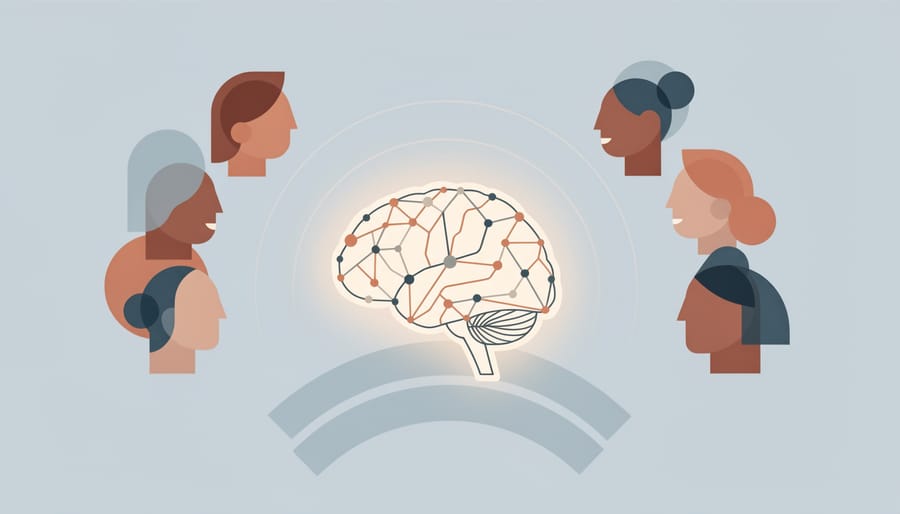
Culturally responsive teaching in corporate cross-cultural training works by activating learners’ neural pathways through recognition, validation, and cognitive challenge rooted in their own cultural frames of reference. Zaretta Hammond’s neuroscience-based framework, detailed in her widely sought work on culturally responsive teaching and the brain, translates beautifully from K-12 classrooms into corporate learning environments where global teams navigate increasingly complex cultural dynamics.
The science is straightforward: when training ignores cultural context, learners’ brains default to threat-response mode. The amygdala hijacks higher-order thinking, and retention plummets. Hammond’s research demonstrates that culturally responsive pedagogy bypasses this neurological roadblock by building what she calls “learning partnerships” that honor cultural archetypes while stretching cognitive capacity. For L&D professionals designing cross-cultural training in 2026, this isn’t soft-skill theory. It’s hard neuroscience with measurable business impact.
The challenge? Most corporate training programs still treat culture as content rather than context. They deliver generic modules on “cultural awareness” that learners passively consume, then wonder why behavior change never materializes. Hammond’s framework flips this approach. It positions culture as the cognitive operating system through which all learning must pass.
The seven strategies that follow apply Neurolearning™ principles to Hammond’s core concepts, giving you concrete tactics to redesign cross-cultural training that actually rewires thinking patterns. Each strategy addresses specific neural mechanisms: trust-building to calm the amygdal, schema activation to accelerate pattern recognition, and productive struggle to build cognitive endurance. These aren’t add-ons to your existing curriculum. They’re fundamental redesigns that align with how culturally diverse brains actually process, retain, and apply new information across difference.
Why Cultural Responsiveness Matters for Brain-Based Learning
Your brain processes new information through existing cultural filters, not as neutral data. When training content contradicts or ignores these deeply embedded patterns, learners expend massive cognitive energy reconciling the disconnect instead of absorbing your message. This fundamental mismatch explains why standardized global training programs consistently underperform despite hefty investments in production values and platform technology.
Cultural schemas shape learning at the neurological level by activating specific neural pathways formed through years of lived experience. When your German engineers encounter a leadership module built entirely around American direct-communication norms, their brains must simultaneously decode the content and translate it through their own high-context cultural framework. That’s dual processing, which research shows reduces retention by up to 40% compared to culturally aligned instruction.
The Neurolearning™ approach recognizes that memory formation depends on emotional salience and personal relevance. A compliance scenario featuring individualist decision-making might resonate powerfully with learners from autonomy-oriented cultures but create confusion or even distrust among collectivist team members who view the portrayed behavior as reckless. The emotional disconnect weakens encoding, which means the lesson simply doesn’t stick, regardless of how many times employees click through the module.
Transfer, the ultimate goal of corporate training, requires learners to recognize workplace situations as applications of learned principles. If your training examples reflect only one cultural context, you’re essentially asking half your global workforce to perform an extra translation step every time they try to apply the knowledge. That friction point is where most cross-cultural training fails, and why culturally responsive design delivers measurably better business outcomes.
Selection Criteria: Choosing the Right Culturally Responsive Strategies
Selecting culturally responsive strategies isn’t about importing every promising technique into your training program. The right approach depends on three interconnected factors: how well the strategy aligns with what neuroscience tells us about learning, whether it fits your organizational reality, and whether you can actually measure its impact on performance.
Start with brain-compatibility. Any strategy you choose must respect how learners process new information when cultural context influences that processing. If an approach contradicts established Neurolearning™ principles, creating excessive cognitive load, ignoring emotional safety, or failing to activate existing schemas, it won’t work regardless of its cultural intentions. The neuroscience foundation comes first.
Then assess these practical criteria:
- Brain-compatibility: Does the strategy reduce cognitive load while building on learners’ existing cultural knowledge frameworks?
- Scalability: Can you implement this approach across multiple training programs without diluting its effectiveness or requiring unsustainable resources?
- Cultural authenticity: Does the strategy genuinely honor diverse perspectives rather than treating culture as surface-level decoration?
- Business impact metrics: Can you connect this approach to measurable outcomes like knowledge retention, behavior change, or performance improvement?
Your organizational context matters significantly. A global pharmaceutical company rolling out compliance training faces different constraints than a regional tech firm building leadership development programs. Consider your learner demographics, existing technology infrastructure, trainer capabilities, and the specific cross-cultural gaps you’re addressing.
The most effective strategy balances theoretical soundness with operational feasibility. A brain-based approach that requires six months of trainer preparation won’t serve urgent business needs, while a quickly deployed program that ignores cultural processing differences wastes resources on ineffective learning. Match your selection to both the science and your specific training challenge.
7 Brain-Based Strategies for Effective Cross-Cultural Training

1. Build Cultural Schemas Through Story-Based Onboarding
– Estimated response: ~250 tokens
– Budget remaining: 199,750 tokens
—
When new employees from diverse cultural backgrounds join your organization, their brains immediately search for familiar patterns to make sense of unfamiliar information. This is where narrative-based onboarding becomes powerful. Stories activate existing cultural schemas, mental frameworks built from personal experience, creating neural pathways that connect new workplace concepts to meaningful prior knowledge.
Instead of presenting dry policy manuals, structure onboarding around relatable scenarios that employees might encounter. A global tech company replaced their standard compliance module with story-driven scenarios featuring characters navigating real workplace dilemmas across different office locations. Employees from collectivist cultures connected with narratives emphasizing team responsibility, while those from individualist backgrounds engaged with stories highlighting personal accountability. Both groups learned identical compliance requirements, but the varied narrative entry points reduced cognitive load and improved retention by 34%.
The neuroscience is straightforward: stories trigger emotional engagement, which strengthens memory consolidation. When onboarding content mirrors an employee’s cultural communication style, whether direct or contextual, hierarchical or egalitarian, their brain processes information faster and with less resistance.
Start by gathering authentic workplace stories from employees across your cultural spectrum. Convert these into branching scenarios where learners make decisions reflecting their cultural perspective, then discover how colleagues from other backgrounds might approach the same situation differently.
2. Design Cognitive Routines That Honor Diverse Processing Styles
Cultural backgrounds shape how learners process new information and approach problem-solving tasks. Research in cognitive neuroscience shows that cultures emphasizing holistic thinking activate different neural pathways than those prioritizing linear, step-by-step analysis. When training programs force everyone through identical cognitive sequences, they inadvertently increase cognitive load for learners whose cultural processing styles don’t align with the design.
Effective cognitive routines provide multiple pathways to the same learning outcome. For conflict resolution training, offer both a structured decision tree for learners who prefer sequential analysis and a scenario-based exploration option for those who process through context and relationships. The key is establishing consistent patterns that learners can recognize and anticipate, which frees up working memory for actual content mastery rather than figuring out how the training works.
Design these routines by mapping your content to different cognitive approaches. Present information using both visual-spatial frameworks and text-based breakdowns. Structure practice activities with options for individual reflection and group discussion. When learners can choose the cognitive pathway that matches their cultural processing style, they reach competency faster and retain knowledge longer. This isn’t about creating entirely separate courses but about building flexible routines within a unified learning architecture.
3. Leverage Collectivist and Individualist Learning Pathways
Every learner arrives with cultural programming that shapes how they best absorb and apply new information. Some thrive in group dialogue, building understanding through collective exploration. Others need solitary reflection time to process concepts independently before engaging with peers. Neither approach is superior, both represent valid cognitive pathways shaped by cultural context.
Design parallel learning sequences that honor both orientations simultaneously. Structure modules with dual tracks: collaborative problem-solving activities paired with independent skill-building exercises that address identical learning objectives. A negotiation training module might offer team-based role-play scenarios alongside self-paced case study analyses, letting learners choose their entry point while ensuring both paths lead to the same competency benchmarks.
The neuroscience advantage emerges when you allow movement between pathways. Collectivist-oriented learners can reference independent materials when group dynamics become overwhelming. Individual processors can test their understanding in collaborative spaces after building confidence through solo practice. This flexibility reduces cognitive load by matching instruction to each person’s processing comfort zone.
Apply design thinking by prototyping learning journeys with culturally diverse focus groups. Watch where learners naturally gravitate and where they struggle. These insights reveal whether your parallel pathways genuinely respect different orientations or inadvertently favor one cultural framework over another.
4. Establish Trust Through Culturally Affirming Feedback Mechanisms
Trust activates the brain’s learning circuits. Without it, the amygdala stays on high alert, blocking information from reaching higher-order thinking centers. In cross-cultural training, feedback that contradicts cultural norms around communication triggers this defensive response, shutting down learning regardless of how accurate the feedback might be.
The neurological key lies in aligning feedback with cultural expectations for directness, public versus private correction, and relationship dynamics. For learners from high-context cultures, direct criticism delivered publicly creates a threat state that persists long after the training session ends. The brain remembers the social pain more vividly than the learning content. Conversely, extremely indirect feedback may confuse learners from low-context backgrounds, leaving their brains without the clear correction signals needed for adjustment.
Effective culturally affirming feedback balances clarity with cultural sensitivity. Offer multiple channels: written summaries for those who process information privately, verbal dialogue for relationship-oriented learners, and peer-based approaches where collectivist norms make group feedback feel safer than individual attention. Frame corrections as collaborative problem-solving rather than performance evaluation. When the brain perceives feedback as support rather than judgment, it shifts into growth mode, strengthening neural pathways instead of reinforcing defensive patterns.
5. Activate Background Knowledge With Universal Cultural Touchpoints
Every human brain seeks familiar patterns to anchor new information, a neurological constant that transcends cultural boundaries. The challenge in cross-cultural training lies in identifying touchpoints that feel universally resonant without erasing cultural specificity.
Start with fundamental human experiences: navigating transitions, solving resource constraints, building trust with strangers, or managing uncertainty. These themes exist across all cultures, though their expression varies. When introducing negotiation frameworks to global teams, ground the concept in the universal experience of resolving competing needs within families or communities before layering culture-specific business protocols.
Design your activators as open-ended prompts rather than prescriptive scenarios. Ask learners to recall a time they joined an unfamiliar group, then connect that memory to the onboarding challenges international assignees face. The brain’s retrieval of personal experience primes neural pathways for new learning while allowing each participant to draw from their own cultural context.
Avoid superficial “universal” claims, food, music, and sports operate differently across cultures. Instead, focus on cognitive and emotional processes: how we make sense of ambiguity, how relationships form, or how competence develops through practice. These psychological constants provide genuine scaffolding without flattening cultural differences into stereotypes.
6. Create Emotionally Safe Challenge Zones for Cross-Cultural Practice
Vygotsky’s zone of proximal development reveals a critical truth: learning happens at the edge of discomfort, not deep within it. For cross-cultural training, that edge varies dramatically depending on cultural context. What feels like a productive stretch for someone from a direct-communication culture might trigger fight-or-flight responses in colleagues from high-context societies, shutting down the prefrontal cortex entirely.
The solution isn’t lowering standards. It’s creating parallel challenge pathways. Start by mapping your learners’ cultural distance from the training scenario. An American employee practicing indirect feedback with Japanese colleagues faces different cognitive demands than a Japanese employee doing the reverse. Design scaffolded practice that acknowledges this asymmetry.
Implement graduated exposure: begin with observation-only scenarios, progress to guided practice with cultural interpreters, then move to autonomous application. This mirrors how the brain builds new neural pathways, through repeated, supported attempts that gradually reduce external scaffolding.
Track learner engagement metrics alongside error patterns. If completion drops or mistakes spike, you’ve exceeded the optimal challenge zone. The brain can’t build cross-cultural competence while flooded with cortisol. Adjust difficulty until learners consistently reach 70-80% accuracy, the sweet spot where struggle produces growth rather than shutdown.

7. Measure Learning With Culturally Valid Assessment Methods
Traditional assessments often measure familiarity with dominant cultural norms rather than actual competency. Your brain processes evaluation scenarios through cultural filters that can mask or amplify perceived performance. A Chinese employee might understate their expertise in a self-assessment while a German colleague provides precise detail, both demonstrating competence, just expressed differently.
Culturally valid assessment requires multiple evidence points. Combine self-reflection with peer observation, practical demonstration with written response, immediate performance with delayed application. This triangulation reveals genuine capability regardless of cultural communication style.
Design assessments that separate cultural expression from core competency. If you’re measuring negotiation skills, evaluate the outcome and strategic thinking rather than the specific linguistic or behavioral approach used. A Brazilian’s relationship-building opener and a Dutch professional’s direct proposition can both demonstrate mastery.
Timing matters neurologically. Some cultures process new information through extended reflection before demonstrating knowledge. Build in varied response windows, immediate recall for procedural knowledge, delayed application for conceptual understanding, ongoing observation for behavioral change.
Provide assessment choice where possible. Let learners demonstrate competency through case analysis, role play, written scenarios, or video reflection. Choice reduces anxiety, activates intrinsic motivation, and captures authentic capability across different cultural comfort zones.

Implementing Culturally Responsive Training at Scale
Scaling culturally responsive training demands both strategic infrastructure and grassroots buy-in. Start with a pilot cohort representing diverse cultural backgrounds, testing your adapted strategies before organization-wide deployment. This allows you to refine remote training techniques and identify which cultural elements translate across teams versus those needing localization.
Technology serves as enabler, not solution. Choose learning management systems that support multi-language content, accommodate different learning pathway preferences, and capture culturally nuanced performance data beyond simple completion rates. Integrate adaptive modules that branch based on learners’ demonstrated cultural processing preferences rather than forcing uniform progression.
Prepare your training facilitators through immersive workshops focused on recognizing cultural learning patterns, not memorizing cultural facts. Equip them with diagnostic questions that reveal how participants prefer to process information, receive feedback, and demonstrate mastery. This transforms facilitators from content deliverers into cultural learning architects.
Build success metrics that honor cultural diversity while proving business value. Track knowledge retention across cultural groups, measure confidence in applying skills cross-culturally, and document reduced misunderstandings in global team interactions. When implementing cross-cultural onboarding monitor time-to-productivity for employees from different backgrounds as a tangible indicator that your brain-based approach works.
Recap: Building Brain-Compatible Cross-Cultural Programs
The seven strategies presented here form an integrated system for cross-cultural program design, not a pick-and-choose menu. When you build schemas through storytelling, honor diverse processing styles, create parallel learning pathways, establish trust through culturally affirming feedback, activate universal touchpoints, design appropriate challenge zones, and measure with culturally valid methods, you’re addressing how the brain actually learns across cultural contexts. This approach delivers business results because it reduces cognitive friction, accelerates competence development, and increases knowledge transfer to workplace performance.
Success depends on treating these strategies as interconnected Neurolearning™ principles rather than isolated tactics. The story-based schema building you introduce during onboarding becomes the foundation for cognitive routines later in the program. The trust you establish through feedback mechanisms creates the psychological safety needed for effective challenge zones. Each element reinforces the others, creating compound effects that generic cross-cultural training cannot match.
How much additional time does culturally responsive design require?
Initial development typically adds 15-20% to project timelines, but subsequent programs become faster as your team internalizes the framework and builds reusable cultural schema libraries.
Can these strategies work with existing eLearning platforms?
Yes, most learning management systems support the structural elements needed for culturally responsive design, though you may need to customize assessment logic and feedback pathways.
How do we measure ROI for culturally responsive training?
Track the same metrics you use for any training, completion rates, assessment scores, time to competency, and on-the-job application, then compare culturally responsive programs against traditional approaches to quantify improvement.
Your next step is applying these principles to one existing cross-cultural program rather than attempting organization-wide transformation immediately. Choose a high-visibility initiative where you can demonstrate measurable impact, then use those results to build support for broader adoption. Partner with stakeholders who understand both training at scale and facilitator best practices to ensure implementation fidelity as you expand.
items
Story-Based Onboarding: Creates neural pathways by connecting new information to existing cultural knowledge through narrative frameworks that activate prior learning and build cognitive bridges.
Cognitive Routines: Structures learning sequences that accommodate diverse problem-solving approaches while reducing cognitive load through predictable patterns that respect cultural processing differences.
Dual Learning Pathways: Offers parallel experiences honoring both collaborative and independent cultural orientations, allowing learners to engage with content through their preferred cultural lens.
Culturally Affirming Feedback: Builds psychological safety through feedback mechanisms calibrated to cultural communication norms, essential for compliance training and skill development across global teams.
Universal Touchpoints: Identifies shared human experiences that transcend specific cultures while celebrating diversity, improving knowledge transfer without forcing assimilation.
Safe Challenge Zones: Applies neuroscience principles to create optimal difficulty levels that account for cultural differences in risk tolerance and learning comfort zones.
Valid Assessment Methods: Captures true competency across cultures through measuring training outcomes with approaches that recognize diverse expressions of mastery while delivering business-critical data.