
Optimal learning theory translates neuroscience research into a practical framework for designing corporate training that sticks. Instead of recycling outdated instructional models, this approach applies what we know about memory consolidation, attention architecture, and cognitive load to create programs that drive measurable behavior change. For L&D professionals, the shift means moving from content delivery to engineering learning experiences that align with how the brain actually processes, stores, and retrieves information.
The science is clear: corporate training fails not because employees lack motivation, but because most programs ignore fundamental principles of human learning. Traditional approaches front-load information, rely on passive consumption, and test recognition rather than application. The brain doesn’t work that way. Optimal learning theory addresses this gap by integrating Neurolearning™ principles with design thinking to create training that respects cognitive constraints while maximizing retention and transfer.
What makes this framework different? Three core commitments. First, spaced repetition replaces marathon sessions because consolidation happens between exposures, not during them. Second, retrieval practice drives design decisions because pulling information from memory strengthens neural pathways far more than re-reading content. Third, metacognitive scaffolding helps learners monitor their own understanding, catching knowledge gaps before they calcify into persistent errors.
This isn’t theoretical window dressing. Organizations applying optimal learning principles see completion rates climb, time-to-competency drop, and performance metrics improve across functions. The difference lies in implementation: building training systems that work with cognitive architecture rather than against it.
The following guide walks you through applying optimal learning theory to your organization’s training ecosystem, from initial audit to verification of results. You’ll learn which tools support the framework, where programs typically break down, and how to measure whether your interventions are actually changing behavior.
What You’ll Need: Essential Components for Optimal Learning Implementation
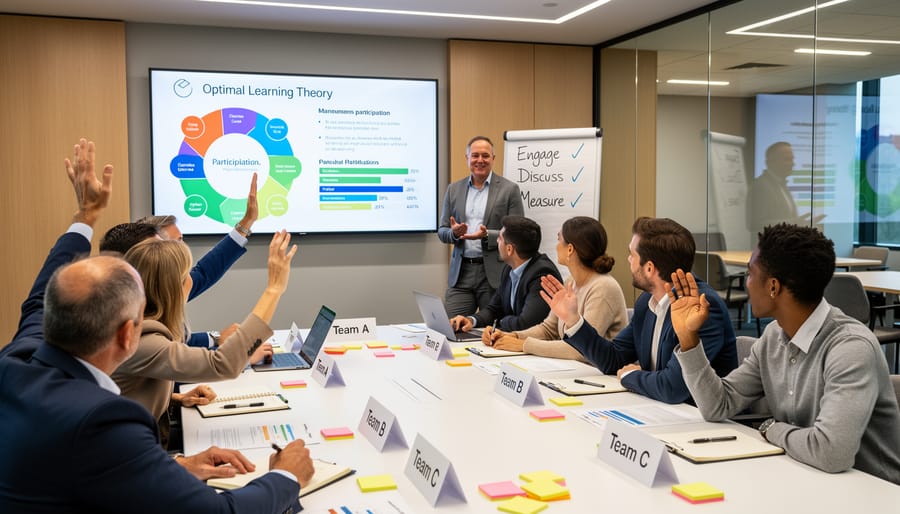
Before you dive into applying optimal learning theory, you need the right foundation. This isn’t about having the fanciest technology or the biggest budget, it’s about ensuring your organization has the essential components to make neuroscience-informed training stick.
The Core Requirements
Successful implementation rests on five pillars:
- Executive and stakeholder buy-in that neuroscience principles will guide design decisions
- Access to learner data including performance baselines, skill gaps, and learning histories
- Content creation tools capable of multimedia development and spaced repetition scheduling
- Assessment mechanisms that measure both knowledge retention and behavioral change
- An organizational culture willing to experiment and iterate based on cognitive science evidence
Let’s be clear about what this means in practice. Stakeholder buy-in goes beyond a nodding agreement in a meeting. You need champions who’ll defend longer development timelines when you’re building retrieval practice into modules instead of one-and-done content dumps. You’ll need managers who understand why their teams are seeing the same concepts revisited over weeks rather than crammed into a single session.
The learner data requirement surprises some L&D teams. You can’t optimize what you can’t measure. That means knowing where learners currently struggle, how they’ve performed in past training, and what their actual job demands look like. If your LMS can’t track progress over time or your organization treats learning data as an afterthought, you’ll struggle to apply spacing principles effectively.
Your content tools don’t need to be expensive, but they must support the brain-based strategies you’ll use. Can you schedule automated reminders for spaced retrieval? Can you create dual-coding experiences that pair visuals with explanations? Can you build branching scenarios that adjust cognitive load based on learner responses?
Finally, culture matters more than most people admit. If your organization demands instant results and resists anything that looks like “doing training differently,” optimal learning theory will feel like pushing water uphill.
Critical Considerations: When Optimal Learning Theory Doesn’t Apply
Not every learning challenge requires a neuroscience-based solution. Before you commit resources to an optimal learning theory implementation, recognize the contexts where traditional approaches actually serve you better.
Time-critical compliance training often demands straightforward information delivery rather than elaborate cognitive strategies. When you need to document that 5,000 employees completed harassment prevention training by month-end, a simple e-learning module with knowledge checks may be your most practical path. The administrative burden of tracking spaced repetition schedules and personalized learning paths can outweigh the retention benefits in purely compliance-driven scenarios.
Watch for these red flags that signal your organization isn’t ready. If leadership views training exclusively as a cost center rather than a performance investment, you’ll struggle to secure the time learners need for retrieval practice and reflection. If your culture punishes mistakes, the low-stakes testing central to optimal learning theory won’t work because learners fear any assessment. If subject matter experts refuse to collaborate on content redesign, you can’t effectively apply cognitive load principles.
Common pitfalls sabotage even well-intentioned implementations. Misapplying cognitive load theory by stripping away all complexity creates oversimplified training that fails to prepare learners for real-world challenges. Ignoring business constraints like production schedules, budget cycles, and competing priorities turns your scientifically sound program into an operationally impossible one. Pursuing retention gains while overlooking transfer to job performance optimizes the wrong outcome.
Sometimes a straightforward job aid, a well-designed checklist, or a single workshop with strong follow-up support solves the problem faster and cheaper than a neuroscience-informed learning architecture. Match the solution to the actual need, not the most sophisticated approach available.
The Five-Stage Process for Applying Optimal Learning Theory
Stage 1: Conduct a Neuroscience-Informed Learning Audit
Before redesigning anything, you need a clear picture of what’s actually happening in your current training ecosystem. This audit isn’t about cataloging course titles or completion rates. You’re investigating whether your existing programs align with how the human brain actually processes, retains, and applies information.
Start by selecting three to five representative training programs that span different formats: an onboarding module, a compliance course, a skills-based workshop. Walk through each as a learner would, documenting every interaction. Ask yourself: Does this program front-load information dumps that overwhelm working memory? Are learners passively watching slides, or actively retrieving and applying concepts? Where does the design create unnecessary cognitive friction?
Use design thinking’s empathy phase here. Interview recent learners about their experiences. Don’t accept “it was fine” as an answer. Probe for specifics: What did they remember a week later? Which parts felt like wasted time? What confused them? Where did they disengage? These conversations reveal the gap between what your LMS reports and what’s actually happening in learners’ brains.
Map your findings against core Neurolearning™ principles. Create a simple matrix: one column for each program, rows for spacing practice, retrieval opportunities, cognitive load management, and dual coding. Mark where programs succeed and where they violate brain-friendly design. You’ll likely discover patterns. Most corporate training fails on spacing and retrieval, cramming information into single sessions without reinforcement.
This audit becomes your baseline. It shows stakeholders the problem in concrete terms and sets measurable targets for improvement.
Stage 2: Map Learning Objectives to Brain-Based Principles
Start by identifying which brain mechanisms drive each business outcome you’ve defined. If your goal is faster onboarding, map it to retrieval practice and spacing effects that strengthen memory consolidation. If you need better problem-solving, connect it to interleaving improves transfer between contexts. This isn’t about applying every principle to every objective. It’s strategic pairing based on how the brain actually processes and retains information.
Create a simple matrix with three columns: business objective, relevant neuroplasticity principles and the specific mechanism you’re leveraging. For example, if your sales team needs to handle objections more effectively, you might map that to retrieval practice (strengthening recall pathways under pressure), dual coding (pairing verbal scripts with visual cues), and interleaving (mixing objection types rather than blocking them by category). The matrix forces you to justify each design choice with cognitive science, not just instructional tradition.
Don’t overcomplicate this. You’re looking for two or three principles that genuinely support each learning goal. If you find yourself listing six principles for one objective, you’re either unclear about what you’re trying to achieve or you’re hedging. Pick the mechanisms that matter most for retention, transfer, and application. The matrix becomes your design blueprint, the reference point when stakeholders question why you’re spacing content over weeks instead of cramming it into a two-day workshop. You’re not guessing anymore. You’re building training on how brains change.
Stage 3: Design Learning Experiences with Cognitive Load in Mind
Working memory holds roughly four chunks of information at once, exceeding this limit causes cognitive overload and learning shuts down. Structure your content to respect this constraint. Break complex processes into discrete modules of 3-5 core concepts maximum. Each module should stand alone before building toward the next layer of complexity.
Strip away decorative elements that compete for mental resources. Every animation, color choice, sidebar, and navigation element consumes cognitive capacity. Ask: does this directly support the learning objective? If not, remove it. Your learners’ working memory is expensive real estate, spend it on what matters.
The brain processes narrative differently than isolated facts. Stories create coherent mental models that stick because they engage multiple neural systems simultaneously, language, emotion, visual imagination, and social cognition. When you wrap a compliance procedure inside a realistic workplace scenario, you’re not just making it interesting; you’re making it memorable. This is why stories fix it when lectures fail.
Scaffolding means calibrating difficulty to each learner’s current capability. Start with worked examples that reveal expert thinking processes. Gradually fade support as competence builds, shift from full demonstrations to partial guidance to independent practice. This prevents both boredom (too easy) and panic (too hard), keeping learners in the productive struggle zone where learning happens.
Use progressive disclosure: reveal information as learners need it rather than dumping everything upfront. Present the core concept, let learners practice, then introduce nuances and exceptions. This respects working memory limits while building toward complexity.
Design thinking applies here too. Test your materials with actual learners. Watch where they stumble, rewind, or zone out. Those friction points reveal cognitive overload you didn’t anticipate. Iterate based on real cognitive responses, not assumptions about what should work.
Stage 4: Implement Spaced Retrieval and Active Learning Strategies

At this stage, you’re moving from design to execution, where theory becomes tangible behavior change. Your implementation needs to interrupt the brain’s natural forgetting curve with strategic repetition while keeping learners actively engaged rather than passively scrolling through slides.
Start by building spaced repetition directly into your training calendar. Research consistently shows that distributed beats massed practice three 20-minute sessions across two weeks outperform a single 60-minute marathon. Schedule initial learning, then revisit the same material at increasing intervals: three days later, then a week, then two weeks. This spacing forces the brain to work harder during each retrieval, which paradoxically makes the memory stronger.
Replace passive review with active recall mechanisms that demand effort from learners. Evidence confirms that retrieval practice strengthens memory more effectively than re-reading content. Implement these techniques in sequence:
- Low-stakes quizzes immediately following each learning module, focusing on application rather than rote memorization
- Scenario-based challenges delivered via email or Slack three days post-training, requiring learners to apply concepts to realistic work situations
- Peer explanation exercises where learners teach back key principles to colleagues, revealing gaps in understanding
- Microlearning refreshers, 90-second video recaps or single-concept reminders, pushed to learners’ devices at optimal intervals
- Manager-facilitated debrief conversations two weeks after formal training, connecting learning to current projects
For remote training contexts, leverage technology to automate spacing. Set your LMS to drip-feed practice opportunities rather than dumping everything into a single session. The goal isn’t more content, it’s strategically-timed engagement that matches how neural pathways actually consolidate.
Stage 5: Create Feedback Loops and Metacognitive Checkpoints

The final stage transforms learners from passive recipients into active architects of their own development. Metacognition, thinking about thinking, sits at the heart of optimal learning theory because self-aware learners adapt faster and retain more.
Build formative assessments that do double duty. Rather than end-of-module quizzes that simply score performance, design check-ins that prompt learners to explain their reasoning. “Why did you choose this approach?” forces retrieval and reveals gaps in understanding before they calcify. These low-stakes moments strengthen neural pathways while giving you diagnostic data on where learners struggle.
Embed reflective practice prompts throughout the learning journey. After each module, ask learners to identify one concept they’ll apply immediately and one they need to revisit. This metacognitive pause shifts learning from consumption to curation, learners become curators of their own development rather than tourists passing through content.
Manager touchpoints complete the feedback loop. Schedule brief conversations three days and two weeks post-training where managers ask specific questions: “What’s one thing you’ve tried from the training? What got in the way?” These aren’t evaluation sessions, they’re transfer accelerators that bridge the knowing-doing gap. Managers reinforce the learning while gathering real-world feedback that informs your next iteration.
Create a shared learner journal where participants post wins and struggles. Peer feedback activates social learning mechanisms and normalizes the messy reality of skill development. When learners see others wrestling with the same challenges, they persist longer.
Measuring Success: How to Verify Your Optimal Learning Implementation Works
Verification means tracking both learning signals and business outcomes, retention rates and assessment scores tell you if knowledge stuck, but only workplace behavior change and performance metrics confirm that optimal learning theory actually works in your context.
Start with learning-level metrics that directly reflect Neurolearning™ principles. Measure retention at 30, 60, and 90 days post-training using unannounced recall assessments, if scores remain above 80%, your spacing and retrieval strategies are working. Track time-to-competency by comparing how quickly learners reach proficiency benchmarks against previous cohorts; a 20-30% reduction signals that cognitive load management and active learning techniques are effective. Monitor assessment performance patterns too: are learners struggling with specific concepts that need redesign, or are they consistently demonstrating mastery?
But learning metrics alone don’t justify investment. Connect your implementation to measurable business outcomes that matter to leadership. Track performance improvement through supervisor ratings, productivity data, or quality metrics in the weeks following training. Document behavior change by observing whether learners actually apply new skills on the job, this is where SoTL in eLearning principles help you gather evidence systematically. Calculate ROI by comparing training costs against measurable gains like reduced errors, faster project completion, or increased sales.
Iteration matters more than perfection. If retention drops after 60 days, increase spacing intervals or add more retrieval practice. If business metrics lag despite strong learning scores, strengthen your Stage 5 feedback loops and manager involvement, knowledge transfer fails when workplace conditions don’t support application. Review your data quarterly, adjust one variable at a time, and document what changes move which metrics. This evidence-based refinement cycle transforms optimal learning theory from a one-time project into a sustainable competitive advantage.
Common Questions About Applying Optimal Learning Theory
How long does a full implementation typically take?
Most organizations see meaningful results within 12-16 weeks, but that timeline varies based on your starting point and scope. If you’re retrofitting existing programs, expect the audit and redesign phases to take 6-8 weeks, followed by a pilot rollout. Greenfield projects where you’re building from scratch can move faster, sometimes as quickly as 8 weeks, because you’re not untangling legacy approaches. The key isn’t speed, it’s strategic sequencing: start with one high-impact program rather than trying to transform everything at once.
What if leadership doesn’t understand neuroscience?
You don’t need to turn your C-suite into cognitive scientists. Frame optimal learning theory in business language they already care about: faster time-to-competency, higher retention rates, better performance outcomes. Share pilot results that connect brain-based design choices to measurable improvements in productivity or error reduction. When a VP sees that spaced retrieval cut onboarding time by 30%, they’ll care less about the hippocampus and more about scaling that approach. The Neurolearning™ framework helps here because it translates science into business cases.
How do you balance optimal learning with compliance requirements?
Compliance training often gets a bad reputation because it’s designed for legal coverage rather than actual learning. The good news? Optimal learning theory makes compliance more effective, not less. Apply spaced retrieval to ensure people actually remember workplace safety protocols six months later, not just on test day. Use scenario-based assessments that require application rather than recognition. You’ll satisfy regulators while building competence that protects your organization in practice, not just on paper.
Can this work with legacy LMS platforms?
Yes, though you may need workarounds. Most platforms support spaced notifications, branching scenarios, and formative quizzes, the core mechanisms you need. Focus on content design and learner experience rather than chasing perfect technology.
How do you train subject matter experts in these principles?
Start with a half-day workshop covering the five Neurolearning™ principles most relevant to content creation: cognitive load, retrieval practice, dual coding, spacing, and interleaving. Then pair SMEs with instructional designers who can translate their expertise into brain-friendly formats.
What if learners resist the changes?
Initial resistance usually fades once people experience better outcomes. Be transparent about why you’re using retrieval practice or spacing, adults appreciate understanding the “why” behind new approaches.
Remember that implementation isn’t a one-time event. Optimal learning theory works best when you treat it as an evolving practice, using design thinking to continuously refine based on what your learners and your business actually need.
Optimal learning theory transforms from abstract neuroscience into tangible business impact when you ground it in systematic application. The five-stage process you’ve just explored isn’t academic speculation, it’s a field-tested framework that consistently delivers stronger retention, faster skill acquisition, and measurable performance improvements across diverse organizational contexts.
What separates effective implementation from surface-level application is the Neurolearning™ approach: treating cognitive science principles as design constraints rather than optional enhancements. When you audit through a brain-based lens, map objectives to neurological mechanisms, manage cognitive load deliberately, build in spaced retrieval, and create metacognitive checkpoints, you’re working with human biology instead of against it.
The organizations seeing the strongest results don’t ask whether these principles work, the research settled that decades ago. They ask how to embed them into their specific training ecosystems, and they commit to the iterative refinement that true optimization requires.
As you move forward, remember that sustainable competitive advantage doesn’t come from acquiring more knowledge. It comes from designing learning experiences that stick, transfer, and compound over time. That’s the promise of optimal learning theory in practice, and it’s entirely within your reach.