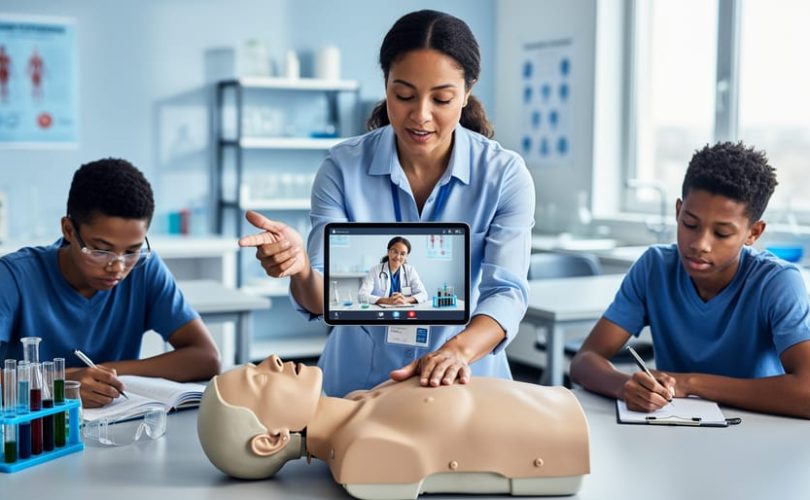
Effective instructional methods require matching your approach to both learner needs and content type, whether you’re training high school students in CPR techniques, implementing science of reading strategies in elementary classrooms, or building telehealth competencies in medical programs. The most successful educators across K-12, higher education, and corporate settings share a common practice: they draw from a repertoire of evidence-based techniques rather than relying on a single approach, adapting their methods based on learning objectives, audience characteristics, and environmental constraints.
The growing interest in instructional methods reflects a fundamental shift in how we understand learning itself. Neurolearning™ research shows that different content and skill types activate distinct cognitive pathways, which means the method that works brilliantly for teaching procedural skills like using an automated external defibrillator may fall flat when building critical thinking or fostering inclusive classroom practices. This isn’t about finding the perfect universal technique. It’s about building your instructional toolkit with methods proven to work in specific contexts, then applying design thinking principles to select and sequence them strategically.
Your choice of instructional method carries measurable consequences. Teachers who engage in professional development that introduces fresh teaching approaches report direct improvements in classroom outcomes. Instructional coaches working with faculty to integrate research-based methods see similar gains. Even in emerging fields where evidence remains limited, such as telehealth training, the intentional selection of appropriate methods separates effective programs from those that simply deliver content.
The framework ahead walks you through selecting, combining, and implementing instructional methods across teaching contexts, with clear verification steps to ensure your approach drives the learning outcomes you need.
What You Need Before Selecting Instructional Methods
Before you can choose the right instructional methods for your context, you need to gather specific tools and information. Whether you’re a K-12 teacher preparing for an inclusive classroom, a university instructor developing specialized skill training, or a corporate learning professional designing employee onboarding, starting with a clear foundation prevents costly missteps and ensures your methods align with actual learner needs.
Understanding Your Learner Population
The first requirement is a detailed profile of who you’re teaching. For early childhood and K-12 educators, this means understanding developmental stages, prior knowledge, and the competencies needed for inclusive classrooms that serve diverse learners. In higher education, you might assess prerequisite skills for specialized training like CPR and AED instruction for high school students. Corporate trainers need demographic data on employees, their current skill levels, job roles, and learning preferences. This population analysis shapes every subsequent decision about which methods will work.
Defining Clear Learning Objectives
You can’t select effective methods without knowing exactly what learners should achieve. Write specific, measurable objectives that answer: What will learners know, do, or demonstrate after instruction? In K-12 settings, this might include reading fluency targets or collaborative skills. For corporate training, objectives often tie directly to job performance metrics or compliance requirements. These objectives become your compass throughout the selection process.
Essential Materials and Resources
To make informed decisions, assemble these foundational elements:
- Learner needs assessment tools to identify knowledge gaps and skill deficiencies
- A framework for articulating learning objectives aligned to standards or competencies
- Access to evidence-based research and current literature on instructional effectiveness
- A catalog of available professional development opportunities and training programs
- Instructional coaching support or peer collaboration networks
Assessing Current Teaching Competencies
Teachers’ instructional methods are influenced by their education, but that foundation needs regular updating. Conduct an honest self-assessment or team evaluation of your current teaching repertoire. What methods do you use most often? Where do gaps exist in your practice? This assessment reveals where professional development can help you gain fresh ideas, teaching methods, and knowledge about your subjects. For corporate trainers, evaluate whether your team has expertise in blended learning approaches that let learners complete content at their own pace while still participating in collaborative sessions.
Access to Professional Learning Resources
Finally, identify what professional development is available. This might include instructional coaching that helps integrate innovative, research-based methods, or formal training like science of reading professional development that provides explicit instructional methods. Recognize that evidence remains limited in some emerging areas, telehealth competencies, for example, so you may need to adapt general principles rather than apply proven blueprints. The key is having pathways to expand your instructional toolkit before you need to deploy new methods in your teaching environment.
Critical Considerations and Constraints
Before investing time and resources in any instructional approach, pause to ensure you’re not setting yourself up for failure. Several critical red flags demand your attention, regardless of whether you’re teaching kindergarteners, college students, or corporate employees.
The most serious warning sign is the absence of measurable outcomes. If a professional development program or training method can’t articulate what learners will be able to do differently afterward, walk away. Vague promises about “enhanced engagement” or “improved classroom culture” without concrete assessment criteria are nearly worthless. This applies equally to K-12 settings, where you need evidence of student learning gains, and corporate environments, where business leaders expect clear ROI.
Generic, one-size-fits-all instructional methods rarely work across diverse learner populations. A technique effective for neurotypical fourth-graders may fail spectacularly in inclusive classrooms serving young children with varied abilities and needs. Similarly, corporate training that ignores employee diversity, different job roles, educational backgrounds, learning preferences, cultural contexts, will produce uneven results at best. Methods must be culturally responsive and adapted to your specific learners, not copied wholesale from another context.
Developmental appropriateness is non-negotiable in K-12 settings. What works for high school students learning CPR and AED use won’t translate to primary grades. Similarly, neuroplasticity principles that enhance adult retention in corporate eLearning require different applications for children’s developing brains.
Finally, corporate training must align with actual business needs. If your instructional method doesn’t address real competency gaps or support strategic objectives, it’s a distraction. Beautiful design thinking workshops that produce no measurable behavior change are resource drains, not solutions.
Step-by-Step Process for Choosing and Implementing Instructional Methods
Step 1: Identify the Specific Learning or Development Need
Start with the learner, not the method. Before selecting any instructional approach, you need a clear picture of who you’re teaching and what they actually need to learn. This means moving beyond assumptions to gather concrete evidence about current competencies, existing gaps, and the specific outcomes you’re targeting.
In K-12 settings, your needs analysis might focus on teachers’ readiness to serve diverse populations. If you’re developing competencies for inclusive classrooms with young children, observe current classroom practices, review student performance data across different learning profiles, and conduct frank conversations with educators about where they feel underprepared. What specific behaviors or skills do teachers need to support children with varied developmental needs?
For specialized skill training, define the precise competency you’re building. Teaching CPR and AED instruction to high school students requires understanding their baseline knowledge, physical capabilities, and common misconceptions about emergency response. Survey students beforehand, consult with health educators, and map the exact steps learners must master.
Corporate contexts demand a similar rigor. Employee onboarding or compliance training starts with identifying performance gaps: What tasks do new hires struggle with? Which regulatory requirements create the highest risk? Interview managers, review incident reports, and analyze completion rates from previous training efforts.
Apply design thinking principles by observing learners in their actual environment, conducting empathy interviews to uncover unstated challenges, and testing your assumptions with small pilot groups. Document not just what learners don’t know, but why the gap exists and what barriers prevent them from applying new knowledge. This foundation ensures you select instructional methods matched to real needs rather than perceived ones.
Step 2: Choose a Professional Learning or Training Approach
With your needs mapped, select the professional learning or training approach that fits your context and constraints. The choice hinges on who you’re developing, K-12 teachers, university faculty, or corporate trainers, and what resources you have available.
Instructional coaching stands out for K-12 and higher education settings where faculty need sustained support integrating research-based methods into their practice. Coaches work alongside teachers to translate theory into classroom action, modeling techniques and providing real-time feedback. This one-on-one or small-group format suits schools and districts investing in long-term instructional improvement, particularly when rolling out approaches like inclusive classroom strategies or new literacy frameworks.
For K-12 teachers shifting to evidence-based literacy instruction, science of reading professional development delivers explicit instructional methods paired with classroom teaching guidance. These programs typically combine foundational workshops with follow-up sessions, equipping educators with phonics routines, assessment tools, and intervention strategies they can apply immediately. Choose this route when your staff needs systematic training in a specific, well-defined methodology.
Blended learning formats work across all contexts but shine in corporate settings where employees juggle training with job demands. This approach lets learners complete foundational content at their own pace, watching videos, reading modules, digesting Neurolearning™ principles, then convene for collaborative sessions to practice skills, troubleshoot challenges, and share applications. The asynchronous-plus-synchronous structure respects busy schedules while preserving the peer interaction that deepens understanding.
Traditional workshops remain viable for introducing specialized skills or compliance topics, such as instructional methods for teaching cardiopulmonary resuscitation and automatic external defibrillator use to high school students. When the goal is hands-on certification or procedural mastery in a compressed timeframe, a concentrated in-person session delivers clarity and immediate practice.
Custom eLearning solutions suit corporate onboarding, compliance training, or skill-building initiatives requiring brand alignment and storytelling elements. Design thinking principles guide the build: you define user needs, prototype modules, test with real learners, and iterate. This option demands upfront investment but scales efficiently across large, distributed workforces.
Match your choice to your population, budget, and timeline, knowing that teachers’ instructional methods are influenced by their education and ongoing development opportunities shape how they teach.
Step 3: Participate in Collaborative or Coached Learning Sessions

Once you’ve identified your learning needs and chosen a professional development approach, the next step is active participation in collaborative or coached learning experiences. This is where educators and trainers translate theory into practical, context-specific techniques.
Instructional coaching offers personalized support. A coach works directly with you to integrate innovative, research-based instructional methods into your classroom or training environment. This one-on-one or small-group setting allows you to address specific challenges, whether you’re implementing explicit phonics instruction aligned with the science of reading or developing competencies for serving inclusive classrooms with young children. The coach observes, provides feedback, and helps you refine techniques in real time.
Collaborative professional development sessions create peer learning opportunities. Many successful programs use a blended approach, letting you complete foundational content at your own pace through online modules, then gathering with colleagues for hands-on practice and discussion. In these sessions, you might simulate teaching CPR and AED use to high school students, share strategies for differentiated instruction, or workshop new techniques with immediate peer feedback.
For corporate trainers, collaborative sessions should incorporate Neurolearning™ principles to maximize retention. Structure peer workshops around spaced practice, retrieval exercises, and storytelling frameworks that mirror how you’ll deliver training to employees. Work with fellow learning professionals to test new onboarding sequences or compliance modules, gathering insights that prevent costly missteps during full rollout.
The key is consistency. Schedule regular coaching touchpoints or peer collaboration sessions, not isolated workshops. This ongoing engagement allows you to test methods, troubleshoot problems, and build confidence before full implementation.
Step 4: Apply the Methods in Your Teaching Environment
With your new instructional methods in hand, you’re ready to put them to work in real teaching scenarios. This step moves from concept to classroom, training room, or digital platform. Start small rather than overhauling everything at once, pilot a single method with a specific group, observe how it lands, and adjust before scaling up.
In K-12 classrooms, applying inclusive strategies means creating deliberate entry points for all learners. If you’ve trained in differentiated instruction, begin by offering multiple ways to access the same content: visual aids for one student, hands-on manipulatives for another, peer collaboration for a third. When implementing explicit phonics instruction grounded in the science of reading, script your lesson sequences to model each sound-symbol relationship clearly, then give students immediate practice with decodable texts that reinforce what you just taught. Watch for confusion or disengagement, these are signals to reteach or modify pacing before moving on.
Higher education settings demand adaptation to more autonomous learners. If you’re introducing active learning techniques, redesign one lecture segment as a case-based discussion or problem-solving workshop, then compare student performance on related assessments. For specialized skill development like CPR and AED training for high school students, break the procedure into discrete steps, demonstrate each one, then supervise repeated practice until competency thresholds are met.
Corporate training benefits when stories fix training that feels abstract. As you roll out employee onboarding or compliance modules, embed narrative scenarios that mirror real workplace challenges, new hires retain policies better when they see a character navigate a dilemma rather than read bullet points. Gather completion data and qualitative feedback within the first week, then refine ambiguous sections or pacing issues before the next cohort starts.
Verification: How to Confirm Your Methods Are Working
Verification depends on systematically tracking both quantitative and qualitative indicators across your specific teaching context. In K-12 and higher education, monitor student performance through formative assessments, standardized test scores where applicable, and classroom engagement metrics such as participation rates and assignment completion. For specialized training, like CPR and AED instruction for high school students, verify competency through practical skill demonstrations and post-training assessments that measure retention of life-saving techniques.
In corporate settings, track training completion rates, pre- and post-assessment scores, and time-to-competency metrics for new hires or employees learning new systems. For remote employee training engagement data becomes particularly valuable: login frequency, module progression, and interaction with collaborative elements reveal whether your blended learning approach is working. Business impact measures, reduced error rates, improved customer satisfaction scores, or decreased onboarding time, connect instructional methods directly to organizational outcomes.
Gather qualitative feedback through surveys, focus groups, and one-on-one conversations with learners and instructors. Ask specific questions: Are learners applying new knowledge? Do teachers in professional development programs feel confident implementing new methods in their classrooms? For instructional coaching sessions that integrate research-based methods, observe whether faculty actually adopt the techniques and whether student outcomes improve as a result.
Recognize that evaluation methods remain under development for some contexts, particularly emerging areas like telehealth competencies where limited evidence exists about effective assessment strategies. When standardized metrics aren’t available, establish baseline measures before implementing new methods, then track changes over time. Create feedback loops that inform continuous improvement: review data quarterly, adjust approaches based on what you learn, and iterate. Verification isn’t a one-time checkpoint, it’s an ongoing cycle that ensures your instructional methods evolve alongside learner needs and organizational goals.
Instructional Methods Across Different Teaching Contexts
The same evidence-based principles that guide instructional method selection adapt powerfully across K-12, higher education, and corporate settings when you tailor them to each environment’s unique developmental and organizational needs.
In K-12 classrooms, effective instructional methods center on developmental appropriateness and inclusive practice. Teachers serving young children focus on developing competencies for inclusive classrooms, ensuring methods accommodate diverse learning needs from the start. Science of reading professional development exemplifies this context-specific approach by providing explicit instructional methods and classroom teaching strategies that match how children’s brains process written language. These methods work because they align with cognitive development stages while maintaining flexibility for individual learners. Professional development helps teachers gain fresh ideas, teaching methods, and knowledge about their subjects, directly enhancing classroom teaching through continuous refinement.
Higher education contexts demand instructional methods that build critical thinking alongside specialized competencies. Consider the instructional methods for teaching cardiopulmonary resuscitation and use of an automatic external defibrillator to high school students: these techniques combine hands-on skill practice with decision-making frameworks that prepare learners for real-world application. Blended learning approaches let teachers complete professional learning at their own pace while still participating in collaborative sessions, modeling the same flexibility they’ll apply with college students. Instructional coaching works with faculty to integrate innovative, research-based instructional methods that challenge students to analyze, synthesize, and apply knowledge rather than simply recall it.
Corporate eLearning solutions adapt these foundational principles to business contexts by emphasizing measurable outcomes and efficiency. Onboarding programs use storytelling to make compliance training memorable, while design thinking frameworks structure skill-building modules around real workplace challenges. Neurolearning™ principles inform spacing and retrieval practice in self-paced courses, boosting retention without extended classroom time. The key difference lies in business alignment: every instructional method must demonstrate clear ROI through improved performance, reduced errors, or faster time-to-competency.
Recognize that teachers’ instructional methods are influenced by their education, but effective adaptation requires understanding your specific learner population. What works for young children won’t directly transfer to adult employees, yet the underlying logic of matching method to cognitive capacity, prior knowledge, and learning goals remains constant across every teaching environment.
Frequently Asked Questions
What’s the difference between instructional methods and teaching strategies?
Instructional methods are the overarching approaches you use to deliver content and facilitate learning, such as direct instruction, inquiry-based learning, or collaborative group work. Teaching strategies are the specific techniques you employ within those methods, like using graphic organizers, asking probing questions, or providing worked examples.
How do I choose between instructional coaching and formal professional development?
Instructional coaching works best when you want personalized, job-embedded support to integrate innovative methods into your actual teaching practice, as coaches help you apply research-based techniques in real time. Formal professional development suits situations where you need structured learning on new content areas, like science of reading approaches with explicit instructional methods, or when an entire team requires the same foundational knowledge before implementation.
Can the same instructional methods work for both children and adult learners?
Many foundational principles apply across age groups, clear objectives, active engagement, feedback loops, and practice opportunities, but the specific application must shift dramatically. Young children in inclusive classrooms need shorter activities, concrete materials, and frequent movement breaks, while adult employees in corporate training benefit from problem-centered scenarios, immediate relevance to their work, and self-directed pacing through blended learning formats.
What should I do when evidence is limited for my teaching context?
Start with methods proven in analogous contexts, then build your own evidence through systematic observation and measurement. If you’re developing telehealth training competencies where research remains sparse, adapt established clinical teaching approaches while documenting what works through learner assessments, performance data, and feedback cycles to refine your approach over time.
How does Neurolearning™ influence instructional method selection?
Neurolearning™ principles guide you toward methods that align with how the brain actually processes and retains information, prioritizing spaced repetition over cramming, retrieval practice over passive review, and emotional engagement through storytelling over dry fact delivery. This framework helps you evaluate whether a method will stick with learners or simply create the illusion of learning without lasting change.
Beyond these common questions, you’ll likely encounter context-specific challenges as you implement new methods. Teachers working with high school students on specialized skills like CPR and AED instruction face different constraints than corporate trainers rolling out compliance modules or elementary educators serving diverse, inclusive classrooms. The key is recognizing that professional development itself, whether through collaborative sessions that let you complete learning at your own pace or through one-on-one coaching, directly shapes which methods you can confidently apply and how well they transfer to your actual teaching environment.
Your education and ongoing learning experiences fundamentally influence which instructional methods feel natural and which require deliberate practice to master. If you trained in traditional lecture-based environments but now work in a setting that demands interactive, student-centered approaches, expect a learning curve. Seek out colleagues who’ve successfully made similar transitions, participate in collaborative professional development where you can observe and practice new techniques with peer feedback, and give yourself permission to refine methods through multiple iterations rather than expecting perfection on the first attempt.

Choosing the right instructional methods for teaching isn’t a one-time decision. It’s an ongoing cycle of assessment, learning, application, and refinement that spans every teaching environment. Whether you’re developing inclusive classroom competencies for young children, training high school students in CPR and AED use, or designing corporate onboarding programs, the core principle remains the same: match evidence-based approaches to your specific learner needs.
Start with a clear needs assessment. Understand who you’re teaching, what they need to learn, and what constraints shape your context. From there, engage in professional learning that gives you fresh ideas and research-based methods, whether through instructional coaching, collaborative sessions, or specialized training in approaches like the science of reading. Apply what you learn in your classroom or training environment, then measure the outcomes rigorously.
This cycle never stops. Teachers’ instructional methods evolve through continued education and professional development. Corporate trainers refine their approaches based on completion rates and competency assessments. Educators across all levels use data to identify what works and what needs adjustment.
Leverage innovation principles like Neurolearning™ and design thinking to deepen engagement and retention. Participate in blended learning opportunities that balance self-paced study with collaborative problem-solving. Most importantly, commit to measurable outcomes, not just activity. When you align your methods with learner needs and continuously refine your practice, you create teaching experiences that truly stick.