
Executive leadership training programs equip senior managers, directors, and C-suite professionals with advanced skills to drive organizational transformation, build high-performing teams, and navigate complex business challenges. Unlike general corporate leadership training these programs target experienced leaders who need to think strategically across functions, lead change at scale, and shape organizational culture from the top.
L&D professionals and HR managers searching for the best programs in 2026 face a crowded landscape. Some offerings are immersive bootcamps, like the Institute on Governance’s Digital Executive Leadership Program (DELP), a 5-day in-person intensive in Ottawa covering digital literacy, leadership skills, and innovative project management. Others blend modular online learning with live coaching, while university-affiliated programs deliver credentials over months. Prices range from a few thousand dollars for short workshops to over $50,000 for extended executive education.
The real question isn’t which program ranks highest, but which design aligns with your leaders’ needs and your organization’s goals. Effective executive development integrates Neurolearning™ principles: spaced practice, scenario-based decision-making, and peer learning that mirrors real workplace challenges. It also honors adult learning preferences by respecting leaders’ time, offering flexible formats, and connecting content to immediate business problems.
This article clarifies what executive leadership programs are, who qualifies, how to enroll, what participants and sponsors can expect, and where to find tailored support. Whether you’re vetting external providers or designing custom solutions, you’ll gain a framework to choose programs that deliver measurable leadership impact.
What Executive Leadership Training Programs Are
Executive leadership training programs are intensive, structured learning experiences built to sharpen the strategic thinking, decision-making, and innovation capabilities that senior leaders need to navigate complexity and drive organizational success. Unlike general management training, these programs target current executives, emerging C-suite leaders, and high-potential managers who are ready to tackle enterprise-level challenges, digital transformation, stakeholder engagement, adaptive leadership, and leading through change. They combine foundational leadership theory with practical application, equipping participants to turn insight into action when they return to their roles.
These programs come in different formats to suit varied organizational needs and learning preferences. In-person bootcamp models offer immersive, focused environments where leaders step away from daily demands to engage deeply with curriculum and peers. The Digital Executive Leadership Program (DELP) from the Institute on Governance exemplifies this approach: a 5-day in-person bootcamp held in Ottawa, running from 9:00 AM to 5:00 PM each day, designed for leaders at all levels of government. The November 2026 session (16-20 November) costs $8,950 and covers digital literacy and leadership skills alongside innovative project management approaches, addressing the real-world demands facing public sector executives today.
Beyond traditional in-person delivery, custom eLearning solutions have become a powerful alternative for organizations with distributed teams, budget constraints, or specific learning objectives that require tailored content. These digital programs leverage Neurolearning™ principles, strategies rooted in cognitive science that improve retention, engagement, and transfer of learning, to make leadership development stick. By incorporating storytelling, scenario-based challenges, spaced repetition, and design thinking exercises, eLearning formats can replicate and even enhance the impact of bootcamp experiences while offering flexibility and scalability.
Whether delivered face-to-face in a concentrated bootcamp or through a blended eLearning journey, effective executive leadership programs share common DNA: they’re designed to stretch participants’ strategic thinking, expose them to diverse perspectives, and provide frameworks they can apply immediately to lead innovation, manage change, and deliver measurable business outcomes.
Who Qualifies for Executive Leadership Programs

Eligibility requirements for executive leadership programs vary widely depending on the provider, organizational context, and target audience. Some programs cast a broad net while others set strict entry criteria to ensure participants can engage at a strategic level.
Programs like the Digital Executive Leadership Program (DELP) from the Institute on Governance are designed for leaders at all levels within the government sector, making them accessible to both emerging and established executives. This inclusive approach recognizes that leadership development needs exist across the organizational hierarchy. In contrast, many corporate programs target a narrower band: mid-to-senior managers with direct reports, C-suite executives navigating digital transformation, or high-potential emerging leaders identified through succession planning processes.
Common eligibility criteria typically include:
- Three to ten years of leadership experience, depending on program intensity
- Current role with strategic decision-making responsibilities or direct team oversight
- Sector-specific requirements for government, healthcare, finance, or other specialized fields
- Organizational sponsorship and budget approval, particularly for higher-investment programs
- Demonstrated readiness for strategic-level thinking and complex problem-solving
Organizational sponsorship often proves more important than individual credentials. Many programs require participants to secure internal support before enrollment, ensuring alignment between personal development goals and business priorities. The $8,950 investment for a program like DELP means most participants need HR or executive approval, which also signals organizational commitment to applying new skills.
Role responsibilities matter as much as tenure. A director managing cross-functional teams and budget accountability will typically qualify before a specialist with equivalent years but no leadership scope. Program providers assess whether candidates face the kinds of strategic challenges the curriculum addresses: leading through change, driving innovation, engaging diverse stakeholders, and making decisions with incomplete information.
Some programs use application essays or leadership assessments to gauge readiness, while others rely on organizational nomination. The key is matching participant experience level to program expectations so everyone can contribute meaningfully and leave with applicable insights.
Core Topics Covered in Executive Leadership Curricula
Executive leadership curricula in 2026 centre on competencies that reflect today’s complex business environment. Programs blend technical fluency with human-centred leadership capabilities, ensuring executives can drive transformation while maintaining team cohesion and stakeholder trust.
Digital literacy sits at the core. Leaders must understand how emerging technologies reshape operations, customer expectations, and competitive dynamics. This doesn’t mean executives need to code; it means they need sufficient technical grounding to ask sharp questions, evaluate vendor proposals, and spot opportunities where digital tools solve real problems. Programs pair digital literacy with leadership skills that help executives guide teams through technological change without creating resistance or confusion.
Innovative project management approaches move beyond traditional waterfall methodologies. Modern programs teach adaptive frameworks that accommodate uncertainty, rapid iteration, and cross-functional collaboration. Leaders learn to balance structure with flexibility, keeping initiatives on track while remaining responsive to market shifts and stakeholder feedback.
Strategic decision-making threads through every module. Executives practise scenario analysis, risk assessment, and resource allocation under time pressure. They wrestle with incomplete information, competing priorities, and stakeholder disagreements, the messy realities that define senior leadership. Change management builds on this foundation, equipping leaders to diagnose organizational readiness, communicate vision clearly, and sustain momentum through implementation challenges.
| Curriculum Topic | Skills Developed | Business Application |
|---|---|---|
| Digital Literacy & Leadership | Technology evaluation, digital transformation oversight, data interpretation | Guiding technology adoption, assessing vendor solutions, building digital culture |
| Innovative Project Management | Adaptive planning, agile methods, cross-functional coordination | Delivering initiatives amid uncertainty, managing hybrid teams, accelerating time-to-market |
| Strategic Decision-Making | Scenario analysis, risk assessment, resource prioritization | Allocating budgets under constraints, entering new markets, managing crises |
| Change Management & Stakeholder Engagement | Communication planning, resistance diagnosis, coalition building | Launching restructuring, merging departments, shifting organizational culture |
Data-driven leadership complements strategic thinking. Executives learn to commission the right analytics, interpret dashboards without drowning in metrics, and translate insights into action. The emphasis falls on asking better questions rather than running analyses personally.
Modern programs increasingly use storytelling and design thinking to make abstract concepts stick. Story frameworks help leaders craft compelling narratives around strategy shifts, making change feel purposeful rather than arbitrary. Design thinking pushes executives to prototype solutions quickly, test assumptions with real stakeholders, and refine approaches based on feedback, a mindset shift for leaders accustomed to polished, fully-formed proposals. These methods anchor learning in application, ensuring concepts transfer from classroom to boardroom.
How to Enroll in an Executive Leadership Training Program

Enrolling in an executive leadership training program requires more preparation than simply signing up. Start by researching programs that align with your career trajectory and your organization’s strategic priorities. Look beyond the marketing materials: review curriculum specifics, instructor credentials, alumni outcomes, and whether the program addresses your actual leadership challenges rather than offering generic content.
Once you’ve identified a promising program, confirm you meet the eligibility requirements. Some programs target specific sectors or seniority levels, while others welcome leaders at various stages. Check prerequisites carefully, years of leadership experience, current role responsibilities, and organizational context all matter. The Digital Executive Leadership Program (DELP), for example, serves leaders at all levels within government, making it accessible to a broader range of public sector professionals than executive-only tracks.
Securing organizational sponsorship comes next. Prepare a business case that connects program outcomes to your organization’s goals. Quantify the investment: the November 2026 DELP session in Ottawa costs $8,950, runs five full days (9 AM to 5 PM), and requires travel and accommodation if you’re not local. Show how topics like digital literacy, leadership skills, and innovative project management approaches will translate into improved decision-making or team performance. Get written approval before you proceed, last-minute funding requests rarely succeed.
The application itself typically requires a current resume and a leadership statement explaining your goals, challenges, and what you hope to gain. Be specific rather than aspirational. Review boards want to see self-awareness and readiness to apply new concepts, not platitudes about “becoming a better leader.”
Timelines vary. In-person bootcamps often have cohort dates months in advance, so plan accordingly. Confirm your registration only after you have organizational approval, budget authorization, and calendar clearance. Block the full program duration, partial attendance defeats the purpose and wastes the investment. For the November 2026 DELP session, that means committing five consecutive weekdays without distractions or competing priorities.
Program Formats: In-Person Bootcamps vs. eLearning Solutions
Executive leadership development in 2026 comes in two primary delivery formats, each designed for different organizational realities and learning cultures. In-person bootcamp models, such as the five-day intensive sessions offered in Ottawa, bring leaders together in a focused, immersive environment. Programs typically run from 9 AM to 5 PM daily, removing participants from day-to-day distractions and creating space for deep strategic thinking. The structured schedule fosters peer networking and relationship-building that extends well beyond the classroom. When senior leaders gather physically, they exchange perspectives across industries, challenge assumptions in real time, and build a support network of fellow executives facing similar organizational complexity.
Custom eLearning solutions offer a contrasting approach that prioritizes flexibility and scalability. Organizations with geographically dispersed teams or leaders who cannot step away for a full week increasingly turn to digital formats that integrate neuroplasticity principles into their design. These programs allow leaders to progress through modules at their own pace, applying new frameworks to current challenges between sessions. The asynchronous nature suits hybrid workforces and reduces travel costs, while incorporating remote employee training methodologies that maintain engagement and accountability. Providers can embed interactive scenarios, decision simulations, and design thinking exercises that adapt to individual leadership contexts, an advantage difficult to replicate in standardized in-person cohorts.
The right format depends on your organization’s size, budget constraints, and how distributed your leadership population is. Smaller organizations with regional concentration may find bootcamps deliver concentrated impact and relationship-building that justifies the investment. Larger enterprises managing leaders across multiple time zones often require digital solutions that reach everyone without coordinating complex travel logistics or pulling entire leadership layers offline simultaneously.
What Participants Can Expect: Rights and Obligations
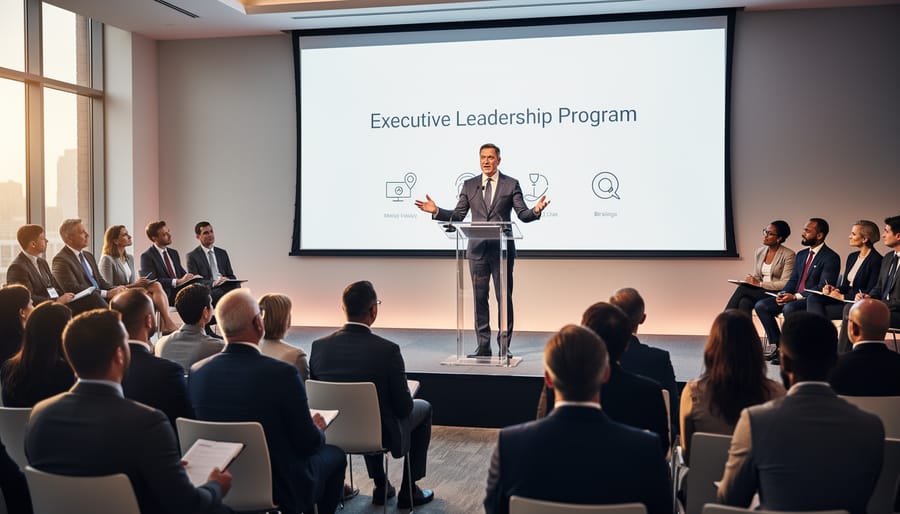
Enrolling in an executive leadership program creates a two-way commitment. Participants receive comprehensive curriculum delivery, all course materials, and access to networking opportunities with peers facing similar leadership challenges. Most programs provide completion credentials or certificates that validate the investment in professional development. For example, the Institute on Governance’s Digital Executive Leadership Program delivers five full days of structured learning from 9 AM to 5 PM, covering digital literacy, innovative project management, and strategic leadership skills alongside facilitated peer discussions and case studies.
In return, participants must commit to full attendance and active engagement throughout the program. Intensive formats require clearing your calendar entirely, missing sessions undermines both your learning and the group dynamic. Many programs assign pre-work or assessments to establish baselines and ensure cohort readiness. The real obligation extends beyond the classroom: you’re expected to apply new frameworks and approaches within your organization, translating learning into measurable leadership impact.
Program fees reflect this level of commitment. The DELP November 2026 session costs $8,950, a typical range for comprehensive executive programs. Organizations sponsoring participants view this as strategic talent investment, not just a training line item. They expect participants to share insights with their teams, champion new initiatives, and demonstrate enhanced decision-making capabilities.
This mutual commitment matters. Providers deliver expertise and structure, organizations invest resources and create space for application, and participants bring full presence and willingness to challenge their assumptions. When all three elements align, executive leadership training moves from credential collection to genuine transformation that ripples through the entire organization.
Where to Get Help and Support Resources
When selecting an executive leadership training program, you need clear pathways to support and expert guidance. Start with program providers who specialize in executive development. Organizations like the Institute on Governance deliver structured offerings such as the Digital Executive Leadership Program, providing transparent pricing, defined curricula, and established track records. Review their materials, speak with program coordinators, and ask about participant outcomes to gauge fit.
Your internal HR and L&D teams are equally critical resources. They understand your organization’s strategic priorities, budget cycles, and approval processes. Engage them early to secure sponsorship, align program selection with workforce development goals, and navigate funding requirements. They can also help you assess whether standardized programs meet your needs or if a custom solution makes more sense.
For tailored leadership development, consider eLearning solution partners who design programs around your unique business challenges. Providers with expertise in Neurolearning™ principles, like Learning Connect, build experiences that improve retention, engagement, and application. Custom solutions offer flexibility for distributed teams and can integrate your organizational context, leadership competencies, and measurement frameworks directly into the curriculum.
When evaluating any provider, ask pointed questions: How do you measure program impact? What instructional design methodologies do you use? Can you share case studies from similar organizations? How will the program address our specific leadership gaps? Request discovery conversations that go beyond surface-level features to explore strategic alignment.
The right support resources combine external expertise with internal advocacy. By leveraging specialized providers, your L&D infrastructure, and partners who understand both leadership development and learning science, you ensure your investment delivers measurable results that advance organizational goals.
Frequently Asked Questions
What exactly are executive leadership training programs?
They’re intensive development experiences designed for current and aspiring senior leaders, focusing on strategic thinking, decision-making under complexity, and the skills needed to lead at the executive level. These programs go beyond basic management training to address the unique challenges facing C-suite and senior leadership roles.
What topics do these programs typically cover?
Modern executive leadership curricula address digital literacy and leadership skills, innovative project management approaches, strategic decision-making, change management, and stakeholder engagement. Many programs also weave in design thinking and data-driven leadership to prepare executives for the realities of leading in 2026.
Are executive leadership programs available online or only in person?
Both formats exist to suit different organizational needs and learning preferences. In-person bootcamps like the 5-day Digital Executive Leadership Program in Ottawa offer immersive, peer-driven experiences, while custom eLearning solutions provide flexibility and scalability for distributed teams using Neurolearning™ principles.
How long do these programs typically run?
Duration varies widely based on format and depth. Intensive in-person bootcamps often run for 5 days with full daily schedules, while eLearning solutions can be structured as multi-week or multi-month journeys with modular components that fit around executive schedules.
These questions reflect what organizations and leaders most commonly ask when exploring executive development options. The answers aim to demystify the category while providing enough specificity to help readers determine whether a particular program model aligns with their needs and constraints. Whether you’re evaluating a government-focused bootcamp or considering a custom eLearning solution for your enterprise leadership team, understanding these fundamentals helps you ask better questions during the discovery process and make more informed investment decisions.