
Teaching English in China in 2026 requires a bachelor’s degree, native or near-native fluency, and a TEFL certificate, with monthly salaries typically ranging from 12,000 to 25,000 RMB (roughly $1,650 to $3,450 USD) depending on your qualifications, location, and whether you work for a public school, private language center, or international institution. You’ll also need to secure a Z visa before arrival, the only legal work authorization for foreign teachers, and verify your employer’s credentials to avoid the scams that continue to plague this market.
The opportunity remains substantial. China’s demand for qualified English instructors persists across tier-one cities like Beijing and Shanghai, smaller provincial capitals, and even rural areas hungry for native speakers. But the landscape has evolved. Stricter visa enforcement means the days of tourist-visa teaching are over, and penalties for illegal work have real consequences. Compensation packages now reflect a more mature market: competitive schools offer housing allowances, flight reimbursements, and contract completion bonuses, while less reputable operations cut corners on support and legal compliance.
Success hinges on preparation and verification. You need to understand the three-step visa process, recognize red flags in job postings (any offer that says you can “sort out the visa after arrival” is a warning sign), and build a document portfolio that includes notarized degree certificates and a clean criminal background check. The application timeline typically spans two to four months from initial contact to your first day in a Chinese classroom.
This guide walks you through the complete process: what credentials and materials you need, how to identify legitimate employers, the exact visa requirements, and verification steps that protect you from fraudulent offers.
What You’ll Need Before Applying
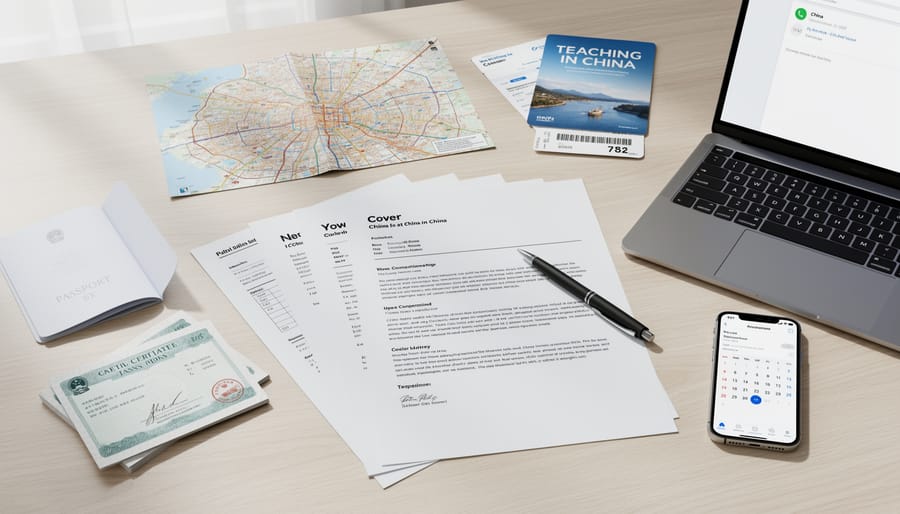
Before you begin researching schools or drafting application emails, assemble the foundation that makes your candidacy credible and legally viable. Teaching English in China isn’t a casual decision, it requires specific documentation, verifiable credentials, and advance preparation that can take weeks or months to complete. Starting this process early prevents delays when you receive an offer and need to move quickly through visa processing.
Your preparation falls into three categories: personal documentation, professional credentials, and preliminary research. Each plays a distinct role in positioning you as a qualified candidate and enabling the Z visa application that authorizes you to work legally in China.
Essential Documentation and Credentials
Gather these core items before submitting applications:
- Valid passport with at least 18 months remaining before expiration and multiple blank visa pages
- Bachelor’s degree certificate (original or certified copy) in any field, properly authenticated or notarized
- Criminal background check from your country of residence, typically valid for six months
- Recent health examination and medical clearance certificate from an approved physician
- TEFL, TESOL, or CELTA certification demonstrating at least 120 hours of training
- Professional reference letters from previous employers or academic supervisors
- Recent professional headshot and passport-style photographs
The degree requirement is non-negotiable for the Z visa process. If you’re still completing your bachelor’s, wait until you have the physical certificate in hand before applying. Authentication requirements vary by country, some documents need apostille stamps or embassy legalization, a process that adds several weeks to your timeline.
Preliminary Research Steps
While assembling credentials, investigate potential employers through online reviews, teacher forums, and direct communication with current or former staff. This groundwork helps you ask informed questions during interviews and evaluate offers against realistic benchmarks. Pay attention to schools’ reputations for honoring contracts, providing promised benefits like housing support and airfare reimbursement, and maintaining professional working environments.
Create a tracking system for application deadlines, school contacts, and document expiration dates. Background checks and health certificates have limited validity windows, so timing their completion around your target start date prevents needing duplicates. This organizational discipline mirrors the design thinking approach, gathering the right tools before starting the actual work streamlines the entire journey from application to classroom.
Understanding Salary and Benefits in 2026
Compensation for English teachers in China varies significantly based on institution type, location, and experience level. In 2026, monthly salaries typically range from $1,500 to $6,000 USD, with the local currency equivalent spanning ¥15,000 to ¥40,000 or higher. Public schools generally offer more conservative pay, around $1,250 to $3,000 per month, while international schools and premium private language centers compete for talent with packages approaching the top end of the scale.
The teaching workload is structured differently than full-time positions in Western countries. Most contracts specify approximately 20 hours per week of actual classroom instruction time. Your schedule will center on weekday daytime teaching which allows evenings and weekends free for personal time and cultural exploration. Administrative duties, lesson planning, and grading add to your overall time commitment, but the core contact hours remain reasonable compared to many domestic teaching roles.
When evaluating offers, look beyond base salary to the comprehensive benefits package. Housing support represents one of the most valuable components, some schools provide fully furnished apartments at no cost, while others offer generous housing stipends that cover most or all of your rent. Airfare reimbursement, typically paid upon arrival or contract completion, offsets your initial travel investment.
Medical insurance coverage is standard across reputable institutions, though the scope and quality vary. Review the specific policy details during negotiations to understand what treatments and facilities are covered. Many schools also include paid training programs that help you adapt to Chinese classroom culture and teaching methodologies, which proves invaluable during your first months.
Additional benefits that enhance the overall value proposition include Mandarin language lessons, a practical perk that accelerates your cultural integration, and contract completion bonuses that reward teachers who fulfill their entire commitment. These bonuses often equal a full month’s salary, serving as both retention incentive and tangible recognition of your dedication.
For context, entry-level positions in smaller cities where salary ranges 10,000-20,000 RMB ($1,370, $2,740) are common. Tier-one cities like Beijing and Shanghai command higher compensation but also carry increased living costs. When comparing offers, calculate your net position after accounting for provided housing, required expenses, and the purchasing power of your salary in that specific location. This holistic view reveals the true financial opportunity each position represents.
Critical Visa Requirements and Legal Warnings

Working legally in China requires absolute clarity on visa requirements. The Z visa stands as the only legitimate pathway to teach English in China, and attempting to work on tourist, student, or business visas carries serious consequences that can end your career abroad before it starts.
Chinese immigration authorities actively investigate and penalize foreigners working without authorization. Schools caught employing teachers on incorrect visas face substantial penalties, which means reputable institutions will never offer you a position without sponsoring your proper work authorization. If an employer suggests you can “start teaching while the paperwork processes” or work temporarily on a different visa type, that signals a fundamental problem with their legitimacy and respect for legal requirements.
The Z visa process typically requires 4-6 weeks from application to approval, which demands planning ahead rather than hoping to arrive and sort out employment on the ground. Your sponsoring school initiates this process by providing official invitation letters and documentation to Chinese authorities on your behalf. This timeline is non-negotiable and cannot be rushed, regardless of when a school needs you to start teaching.
Think of visa compliance as the foundation for everything else you’ll build in China. Just as quality onboard new employees programs and effective training techniques require proper structure, your teaching career in China depends on correct legal authorization from day one. Schools offering cross-cultural training and strong remote training tips during onboarding demonstrate the professional standards that align with proper visa sponsorship and legal employment practices.
Step-by-Step: From Application to Classroom

Finding and Evaluating Teaching Positions
Start by identifying schools that align with your professional goals and teaching philosophy. Online teaching platforms, international recruitment agencies specializing in China placements, and school websites serve as primary research channels. Look beyond the salary figure, while compensation matters, the learning environment and growth opportunities shape your day-to-day experience.
When evaluating schools, request specific details about class sizes, curriculum structure, and student demographics. A reputable institution will provide transparent answers and written documentation. Check teacher reviews on independent forums and ask to speak with current or former staff members. Schools confident in their reputation welcome these conversations.
Compare compensation packages systematically. In 2026, salaries typically range from $1,500 to $6,000 monthly, but the complete picture includes housing support, airfare reimbursement, medical insurance, and contract completion bonuses. A lower base salary with comprehensive benefits often outweighs a higher figure with minimal support. Calculate your net position after accommodation costs, some schools provide furnished apartments while others offer housing allowances that may not cover market rates in tier-one cities.
Apply Neurolearning™ principles when assessing professional development offerings. Schools that invest in ongoing teacher training, peer collaboration time, and exposure to innovative teaching methodologies demonstrate commitment to learning culture. Ask what continuing education opportunities exist, whether the school supports advanced certifications, and how teaching practices are evaluated and improved. These elements indicate whether you’ll grow professionally or simply repeat the same year multiple times.
Red flags include vague contract terms, reluctance to provide written agreements, or pressure to accept offers immediately without time for due diligence.
Navigating the Z Visa Application
Your employer will lead the Z visa process, but you’re responsible for providing complete, accurate documentation. Once you’ve accepted an offer, your school will issue a formal invitation letter and begin sponsoring your application, this is your signal to start gathering paperwork.
Request a detailed checklist from your employer immediately. Most schools require a valid passport (with at least six months remaining), recent passport photos, your degree certificate, background check, medical examination results, and TEFL certification if applicable. Verify each document’s format requirements early; some must be notarized, authenticated, or translated, which adds time you can’t afford to waste.
Organize your documents in a dedicated folder, physical and digital. Scan everything as you collect it, label files clearly (Passport_Scan_2026, Degree_Notarized), and keep a checklist where you tick off each item as completed. This simple system prevents frantic searches when your employer requests a specific document on short notice.
Submit materials to your employer promptly. They’ll forward your packet to Chinese authorities to obtain your work permit notification letter, then send that document back to you so you can apply for the actual Z visa at your nearest Chinese consulate. This back-and-forth accounts for much of the 4-6 week timeline, so every delay you introduce extends the entire process.
Maintain regular contact with both your employer and the consulate. Confirm receipt of each submission, ask for status updates weekly, and respond to requests within 24 hours. Track key dates, when documents were sent, when follow-up is due, on a calendar rather than trying to remember.
The process feels bureaucratic, but it’s straightforward when you stay organized and responsive. Treat each requirement as non-negotiable, submit clean documentation, and you’ll receive your visa with time to prepare for departure.
Preparing for Arrival and Onboarding
Once your Z visa is approved and you’ve confirmed your arrival date with your employer, focus on practical preparations that go beyond packing. Arrange airport pickup with your school’s HR contact, clarify who will meet you and how you’ll recognize them. Confirm your first week’s schedule in writing, many schools provide structured orientation that covers housing handover, bank account setup, local SIM card registration, and introductions to administrative staff. Request these details in advance so you can plan accordingly.
Quality employer onboarding mirrors effective employee orientation programs: it accelerates your transition from newcomer to confident contributor. Expect your school to walk you through classroom technology, curriculum frameworks, and student assessment protocols during your first days. At Learning Connect, we’ve found that well-designed onboarding reduces anxiety and builds competence faster, the same principle applies whether you’re training corporate teams or settling into a Chinese classroom.
Ask your employer about Mandarin lesson schedules and paid training opportunities mentioned in your contract, and clarify when benefits like housing allowances and medical insurance activate. Document everything. Keep copies of your lease agreement, work permit, and residence permit in both digital and physical formats. Establish a direct contact at your school for questions that arise outside formal orientation sessions.
The teachers who settle in fastest treat onboarding as active partnership rather than passive reception. Prepare thoughtful questions about curriculum expectations, student demographics, and professional development resources. This approach positions you as an engaged professional from day one.
How to Verify Your Offer and Confirm Next Steps

Before committing to a position and relocating internationally, you need concrete proof that your offer is legitimate and legally compliant. Start by requesting a formal written contract that itemizes your monthly salary (verify it falls within the $1,500, $6,000 range typical for 2026), specifies your teaching hours, and lists all promised benefits such as housing support, airfare reimbursement, medical insurance, and any completion bonuses. This document protects you if disputes arise and serves as your reference throughout the visa process.
Confirm that your employer will sponsor your Z visa application, the only legal authorization to work as an English teacher in China. Ask for a detailed timeline explaining the 4-6 week processing period and request copies of the documentation they’ll provide, including the invitation letter and work permit notification. If a school suggests you can start on a tourist visa and “convert later,” that’s an immediate red flag. Working without proper authorization carries serious legal consequences and indicates an employer willing to cut corners.
Watch for warning signs beyond visa irregularities. Schools that refuse video calls, provide only generic email addresses rather than official domains, or pressure you to decide immediately without reviewing contracts deserve skepticism. Legitimate employers understand that qualified teachers need time to evaluate offers and prepare for international relocation. Research the school’s online presence, request contact information for current or former teachers, and verify that the institution appears in official education directories.
Once you’ve validated the offer, establish clear communication protocols with your hiring contact. Confirm who will coordinate your arrival logistics, where you’ll stay initially, and what onboarding support the school provides during your first weeks. Understanding these practical details before departure prevents confusion and sets you up for a smooth transition into your new teaching role.
Common Questions About Teaching English in China
What is the typical salary range for teaching English in China in 2026?
English teachers in China earn between $1,500 and $6,000 per month, with public school positions typically offering $1,250 to $3,000 monthly. Your specific salary depends on factors like school type, location, and teaching experience.
Can I teach legally in China without a Z visa?
No. The Z visa is the only legal authorization to work as an English teacher in China. Teaching on any other visa type violates immigration law and puts you at serious legal risk, including deportation and future entry bans.
How long does the Z visa application process take?
The Z visa typically takes four to six weeks to process. Your sponsoring employer will guide you through the application steps, but you should plan ahead and avoid making travel arrangements until your visa is approved.
What benefits can I expect beyond salary?
Most schools offer housing support or allowances, airfare reimbursement, medical insurance, paid training, Mandarin lessons, and contract completion bonuses. Review your offer carefully to confirm which benefits are included in your specific package.
How many hours will I work each week?
Teachers generally work around 20 hours of classroom instruction per week, with additional time for lesson planning and preparation. Most positions follow weekday daytime schedules, though exact hours vary by institution.
Beyond these core questions, many prospective teachers wonder about classroom dynamics and teaching approaches. Implementing culturally responsive strategies helps you connect with Chinese students and creates more effective learning environments. Remember that teaching abroad requires flexibility and openness to different educational philosophies.
Your success depends on thorough preparation before you apply. Verify every detail in writing, research your prospective employer carefully, and never skip the Z visa requirement regardless of what anyone tells you. The schools that prioritize legal compliance and transparent communication typically offer the best working conditions and professional support.
Securing a teaching position in China isn’t a casual decision, it’s a professional move that demands careful planning and attention to legal detail. The Z visa requirement isn’t negotiable, and working on any other visa type puts your career and legal status at risk. Likewise, understanding the realistic salary range of $1,500 to $6,000 monthly helps you evaluate offers critically rather than accepting the first opportunity that appears.
When you approach this process with the same rigor you’d apply to any international career transition, the rewards become clear. You’ll gain invaluable cross-cultural teaching experience, earn competitive compensation with benefits like housing support and airfare reimbursement, and develop skills that distinguish you in the global education market. The teachers who thrive are those who verify every detail, ask the hard questions about visa sponsorship and contract terms, and treat the application process as a professional partnership rather than a transaction.
At Learning Connect, we believe meaningful educational experiences begin with thoughtful preparation and intentional design. Whether you’re creating eLearning solutions or building a teaching career abroad, the principle remains constant: invest the time upfront to understand requirements, set clear expectations, and establish legitimate partnerships. The structured approach outlined here isn’t just about compliance, it’s about positioning yourself for genuine professional growth in one of the world’s most dynamic education markets.