
Reflective practice in teaching is the deliberate process of analyzing your own instructional methods, learner outcomes, and design decisions to continuously improve the effectiveness of your training programs. It transforms teaching from a series of one-off events into an evolving, evidence-informed discipline where every learning experience becomes data for the next iteration.
For L&D professionals navigating the demands of 2026’s workplace learning landscape, reflective practice isn’t optional. Organizations expect measurable ROI from every training dollar, learners demand experiences that respect their time and cognitive capacity, and the half-life of workplace skills continues to shrink. The trainers and instructional designers who thrive are those who build systematic reflection into their workflow, turning each course deployment into a laboratory for improvement rather than a checkbox exercise.
Yet reflection often gets squeezed out by production deadlines and stakeholder requests. The irony is sharp: we design elaborate learning journeys for our audiences while rarely examining our own practice with the same rigor. When reflection does happen, it’s frequently superficial, a quick post-mortem that focuses on logistics rather than learning science.
This article maps a different approach. You’ll discover how reflective practice operates as a structured methodology grounded in established frameworks like Kolb’s experiential learning cycle and Schön’s reflection-in-action model. We’ll explore how design thinking principles amplify reflective practice, creating a feedback loop between learner experience and instructional innovation. You’ll see concrete applications in corporate eLearning contexts, from analyzing completion data through a Neurolearning lens to redesigning assessments based on cognitive load patterns. Most importantly, you’ll learn implementation strategies that make reflection sustainable rather than aspirational, embedding it into your existing design process without adding unsustainable overhead.
What Reflective Practice in Teaching Means

Reflective practice in teaching is the deliberate, structured process of examining your instructional methods, analysing learner outcomes, and questioning the decisions you make as an educator or instructional designer. It’s metacognition applied to pedagogy: thinking critically about how and why you teach the way you do, then using those insights to make informed changes that improve learning effectiveness.
This isn’t casual post-training reflection or vague feelings about what went well. True reflective practice requires intentional observation, honest evaluation, and a willingness to challenge your own assumptions. You might ask: Did learners actually achieve the stated objectives? Which activities produced genuine comprehension versus surface engagement? What biases shaped my instructional choices? Where did the design fail to meet real workplace needs?
The concept has deep roots in adult learning theory, particularly the work of John Dewey, who argued that experience alone doesn’t guarantee learning. Learning happens when we reflect on experience, extract meaning, and apply new understanding to future action. David Kolb later formalized this into his Experiential Learning Cycle, showing how reflection transforms concrete experience into abstract concepts we can test and refine.
- Reflective Practice
- The systematic examination of one’s teaching methods, learner outcomes, and instructional decisions to identify strengths, weaknesses, and opportunities for improvement.
- Metacognition
- Thinking about your own thinking, awareness and analysis of your cognitive processes, decision-making patterns, and learning strategies.
- Iterative Design
- A cyclical approach to development where you create, test, gather feedback, refine, and repeat to progressively improve a learning solution.
- Experiential Learning Cycle
- Kolb’s four-stage model showing how learners move from concrete experience through reflective observation and abstract conceptualization to active experimentation.
For corporate trainers and instructional designers in 2026, reflective practice matters more than ever. Learning environments have grown complex, blending synchronous and asynchronous formats, AI-assisted personalization, and hybrid work realities. Learners demand relevance and efficiency. Stakeholders expect measurable business impact. Generic, one-size-fits-all training no longer suffices.
Reflective practice gives L&D professionals a disciplined method to keep pace with these demands. It transforms you from a content deliverer into a learning scientist who experiments, gathers evidence, and continuously optimizes. When integrated with design thinking principles and data analytics, reflection becomes your competitive advantage, ensuring every training iteration is smarter, more targeted, and more effective than the last.
How Reflective Practice Works in Teaching

The Role of Design Thinking in Structured Reflection
Design thinking doesn’t just improve eLearning outcomes, it builds reflection directly into the development process. Each of the design thinking phases creates natural pause points where instructional designers and trainers must step back, question their assumptions, and adjust based on what they’ve learned.
Start with empathy mapping. When you interview learners, observe their actual work context, and document their pain points, you’re not just gathering requirements. You’re creating structured opportunities to reflect on the gap between what you thought learners needed and what they actually struggle with. This early reflection prevents you from building courses that answer questions nobody’s asking.
The define and ideate phases force another layer of reflection: Are we solving the right problem? When your team synthesizes research findings and reframes the learning challenge, you’re reflecting on patterns, questioning your initial hypotheses, and prioritizing what truly matters for performance outcomes. This isn’t abstract philosophizing, it’s deciding whether to build a compliance module or a decision-support job aid.
Prototyping and testing deliver the most powerful reflection moments. You create a low-fidelity version of your solution, watch real learners interact with it, and confront the uncomfortable truth: what you designed isn’t landing the way you expected. Maybe your microlearning module is too text-heavy. Perhaps learners need the information at a different workflow moment. These insights only emerge when you test early and reflect honestly on the results.
The iteration loop, refine, test again, reflect again, transforms one-time reflection into a continuous practice. Each cycle sharpens your instructional judgment and builds a team habit of questioning, learning, and improving based on evidence rather than assumption.
Types and Models of Reflective Practice
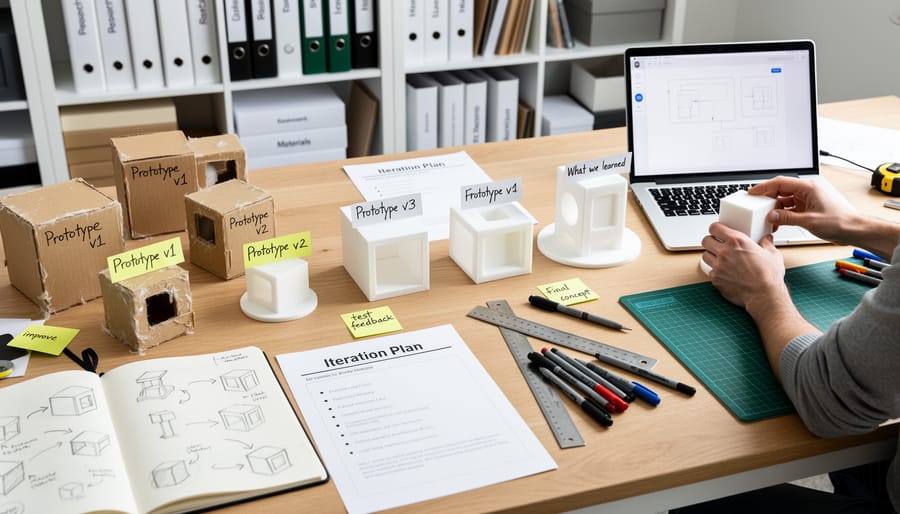
Several foundational models give structure to reflective practice, each offering a distinct lens for examining teaching and learning. Understanding these frameworks helps L&D teams choose approaches that match their organizational culture and training goals.
Kolb’s Experiential Learning Cycle remains one of the most widely applied models in corporate training. It maps learning as a four-stage loop: concrete experience, reflective observation, abstract conceptualization, and active experimentation. For instructional designers, this translates cleanly into eLearning development. You run a pilot course (concrete experience), gather learner feedback and analytics (reflective observation), identify patterns and principles about what worked or failed (abstract conceptualization), then redesign and test changes (active experimentation). The cycle’s strength lies in its emphasis on moving from observation to theory to action, preventing teams from getting stuck in endless analysis without implementation.
Schön’s dual concepts of reflection-in-action and reflection-on-action capture two different moments when learning professionals evaluate their work. Reflection-in-action happens in real time during facilitation or while monitoring live learning experiences, when a trainer adjusts mid-workshop after sensing learner confusion, or when a designer pivots during a user testing session based on immediate feedback. Reflection-on-action occurs after the fact: the post-mortem meeting, the quarterly training effectiveness review, the careful analysis of completion rates and assessment scores. Both matter. Reflection-in-action builds adaptive expertise; reflection-on-action creates systematic improvement. Mature L&D teams practice both deliberately rather than relying on instinct alone.
Gibbs’ Reflective Cycle breaks reflection into six stages: description, feelings, evaluation, analysis, conclusion, and action plan. This structure works particularly well for team retrospectives because it acknowledges the emotional dimension of teaching and learning, something corporate environments often neglect. When a compliance course fails to engage employees, Gibbs’ model prompts designers to examine not just what happened and why, but how the experience felt for learners and facilitators. That emotional data often reveals barriers that pure analytics miss: frustration with navigation, anxiety about assessment stakes, boredom from tone-deaf content.
These models aren’t mutually exclusive. Many successful L&D teams blend elements: using Kolb’s cycle to frame quarterly design sprints while applying Gibbs’ questions to individual course reviews. The right model depends less on theoretical elegance and more on which framework your team will actually use consistently to drive measurable improvements.
How Reflective Practice Is Used in eLearning Design
Integrating Neurolearning™ Principles with Reflective Practice
Reflective practice becomes exponentially more powerful when grounded in how the brain actually learns. Instead of vaguely asking “Did this work?”, Neurolearning™ pushes you to examine specific cognitive mechanisms. When a module fails to stick, reflection guided by brain science reveals whether you overloaded working memory, ignored the spacing effect, or missed the emotional hook that drives encoding.
Start by reflecting on cognitive load. After delivering training, ask: Did learners juggle too many concepts simultaneously? Were instructions split between competing visual and auditory channels? Neuroplasticity principles show that information must be consolidated before new layers can build on top. If post-training performance lags, reflection might reveal you crammed three complex procedures into one session when the brain needed deliberate practice on each individually.
The spacing effect demands similar scrutiny. Reflective practitioners examine their content distribution: Did we provide spaced retrieval opportunities, or dump everything in a single marathon session? When retention drops off after 30 days, effective reflection connects that outcome to the absence of strategic repetition intervals that strengthen neural pathways.
Emotional engagement deserves equal attention. Learning happens fastest when emotions activate the amygdala and hippocampus together. Reflect on whether your training triggered genuine emotional responses or remained clinically detached. Research shows stories fix training precisely because narrative structure creates emotional investment that traditional bullet points cannot match.
For distributed teams, these reflections take on added dimensions. When evaluating remote training techniques consider whether asynchronous formats provided sufficient retrieval practice or whether isolation reduced the social-emotional context that aids memory formation. Brain-based reflection transforms “it didn’t work” into actionable insights: reduce extraneous load, space critical concepts across days, and engineer emotional resonance into every learning touchpoint.
Building a Culture of Reflection in L&D Teams
Building a culture where reflection becomes routine, not an afterthought, requires deliberate structural changes, not just good intentions. L&D leaders who succeed here embed reflective touchpoints into everyday workflows, making examination and iteration as natural as project kickoffs or deadline reviews.
Start with structured retrospectives after every significant project milestone. These aren’t generic debriefs. Use focused prompts: What learner behavior surprised us? Which design decisions worked better than expected, and why? Where did our assumptions about the audience miss the mark? Capture these insights in a shared repository that teams can reference when starting new projects, turning individual reflection into organizational knowledge.
Collaborative design reviews shift reflection from solo activity to team learning. Rather than presenting polished work for approval, create sessions where designers walk through their decision-making process, why they chose a particular interaction model, how they addressed conflicting stakeholder requests, what trade-offs they made. This transparency builds collective expertise and surfaces patterns that individuals working alone might miss. Rotate who leads reviews so every team member practices articulating their thinking.
Learner journey mapping sessions generate rich reflective material. Map the actual path learners take through a program, noting drop-off points, repeated attempts, support requests, and completion patterns. Compare this real journey against your intended design. The gaps between expectation and reality become concrete starting points for reflection rather than abstract questions about effectiveness. This approach also strengthens culturally responsive training by revealing where assumptions about learner context don’t match diverse user experiences.
None of this works without psychological safety. Teams need explicit permission to identify what didn’t work, including their own misjudgments, without fear of blame or career consequences. Leaders model this by openly reflecting on their own decisions first. When a senior instructional designer shares what they’d do differently, it signals that honest evaluation strengthens credibility rather than undermining it.
Finally, protect time for reflection. Schedule it as non-negotiable calendar blocks, just like client meetings. Reflection squeezed into leftover moments rarely produces insights worth capturing.
Common Challenges and How to Overcome Them

Time remains the most frequently cited barrier to reflective practice. L&D teams juggle urgent project demands, stakeholder requests, and back-to-back deliverables, leaving reflection feeling like a luxury they can’t afford. The solution isn’t finding more time but building reflection directly into existing workflows. Schedule 15-minute team retrospectives immediately after each project milestone. Use design thinking’s prototype-test loop as natural reflection checkpoints: every testing session becomes an opportunity to examine what worked, what confused learners, and what assumptions proved wrong. Track time spent on rework caused by skipping reflection; most teams discover that investing 30 minutes in structured reflection saves hours of unnecessary revision later.
Lack of structure turns reflection into vague navel-gazing that produces no actionable insights. Teams discuss “what went well” without examining why it worked or how to replicate success. Combat this by adopting simple frameworks: Gibbs’ Reflective Cycle or the empathize-define-ideate structure from design thinking. Ask specific questions tied to measurable outcomes, Did completion rates match our target? Which module had the highest drop-off? What learner feedback surprised us?, rather than open-ended “How did it go?” prompts. Document reflection outcomes in shared spaces where the whole team can reference them during future projects.
Measuring reflection’s ROI challenges organizations accustomed to hard metrics. Connect reflective practice to business outcomes by tracking leading indicators: How many design iterations did reflection prompt? Did those changes improve completion rates, knowledge retention scores, or time-to-competency? Compare projects where teams reflected systematically against those where they didn’t. Organizations that integrate insights from teaching and learning research into their reflection protocols often see faster course improvements and fewer post-launch fixes.
Resistance to critique stems from cultures where mistakes signal incompetence rather than learning opportunities. L&D leaders must model vulnerability by openly discussing their own missteps and what they learned. Frame reflection around “What would we do differently?” instead of “What went wrong?” Separate reflection from performance reviews entirely. When team members trust that honest evaluation won’t jeopardize their standing, they share the insights that drive genuine improvement.
Frequently Asked Questions
Reflective practice often raises practical questions for L&D teams navigating implementation in fast-paced business environments. Here are answers to the concerns we hear most frequently.
How much time should teams realistically dedicate to reflective practice?
Start with 15-20 minutes after each significant project milestone or course launch, then schedule monthly 45-minute team retrospectives. The key isn’t volume but consistency and intentional structure.
What tools actually support meaningful reflection in corporate eLearning?
Digital whiteboards like Miro or FigJam work well for collaborative reflection mapping, while project management tools with retrospective templates (Trello, Asana) help track insights over time. Learning analytics platforms provide the data foundation for evidence-based reflection.
How do you measure the impact of reflective practice on business outcomes?
Track iteration velocity (how quickly you improve courses based on insights), learner performance gains between course versions, and time-to-competency improvements. Compare completion rates and knowledge retention before and after implementing structured reflection processes.
How does reflective practice differ from standard course evaluations?
Course evaluations gather learner feedback on what happened. Reflective practice examines why it happened, what assumptions drove your design decisions, and how your thinking needs to evolve. It’s the difference between collecting data and developing wisdom.
The most successful L&D teams treat these questions not as obstacles but as design challenges themselves. They prototype reflection processes just as they would a new course module, testing what works for their specific organizational culture and adjusting based on actual team engagement and measurable improvements in learning outcomes.
Reflective practice in teaching isn’t just another professional development checkbox. When you integrate it with design thinking methods and Neurolearning™ principles, it becomes a systematic approach to building better learning experiences that deliver measurable business impact.
The organizations seeing the strongest returns on their L&D investments share a common trait: they’ve embedded reflection into their development process. They don’t wait for annual reviews to ask what worked. Instead, they create regular touchpoints where instructional designers and trainers examine learner data, test assumptions, and refine their approach based on evidence. This iterative mindset, borrowed from design thinking, transforms one-off courses into evolving learning ecosystems that adapt to real needs.
The competitive advantage is clear. Companies that reflect intentionally move faster, waste less budget on ineffective training, and build learning cultures where improvement is continuous rather than sporadic. They understand which instructional strategies align with how the brain actually learns, and they adjust accordingly.
Start small. Choose one element of your next eLearning project and commit to examining it critically after launch. Review completion data, gather qualitative feedback, or conduct a quick retrospective with your team. Ask what you’d change and why. That single act of deliberate reflection sets a foundation you can build on, project after project, until continuous improvement becomes how your organization naturally works.